We use cookies to run this site. With your consent, we also use them for our demo scheduler, analytics and marketing, including identifying the companies and people who visit us. Change your choice anytime under "Cookie Preferences".Privacy Policy
🚀 Dextr AI raised $6.7M to bring an AI workforce to hospitality. Learn more 🚀 Dextr AI raised $6.7M to bring an AI workforce to hospitality. Learn more
Buyer's GuideHotel OwnersGMsCampground & RV Park Operators
The 10 Best Hotel Chatbots for 2026: Which Ones Answer, and Which Ones Finish the Job
Most hotel chatbots can answer a question. Fewer can post the early check-in fee to the folio, send the access code, collect the payment and hand the hard cases to your team with the whole conversation attached. I compared 10 of them on exactly that.
A hotel chatbot is software that answers guests in writing, on your website, by text, on WhatsApp and in the Booking.com and Expedia inboxes, at any hour. The best hotel chatbots for 2026 are Dextr AI (Alfred), Canary Technologies, Conduit, Akia, HiJiffy, Asksuite, Quinta (formerly Quicktext), Duve, HelloShift and Bookboost. What separates them is not how well they chat. It is what they can finish once the guest has asked: an upsell posted to the folio, an access code sent, a payment collected, a request handed to the right person.
Below you’ll find a quick comparison, the 10 chatbots with what each one finishes, lessons from Dextr AI’s own deployments, how the same chatbot works at campgrounds and RV parks, what they cost where prices are public, and the questions to ask in a demo. For each chatbot, I stuck to what the vendor publishes about itself, and I say where each one is the better choice.
Key takeaways
Judge a hotel chatbot by what has changed in your systems when the conversation ends. If the only answer is “the guest got a reply,” it’s an FAQ bot. Our guide to AI agents versus chatbots explains the test.
The revenue sits in three jobs most chatbots leave half done: upsells that land on the folio, access codes that arrive without a phone call, and payments collected in the same thread.
Guests switch to text faster than most operators expect. At one campground, calls were nearly half of all guest contact early in the rollout; by July, 1,582 conversations in a single month were almost all texts.
The handoff decides whether your staff trust the bot. In every demo, ask to see a manager take over a live conversation with one reply, and the AI pick it up again afterwards.
Five of the ten publish a price: Conduit, HiJiffy, Duve, HelloShift and Bookboost. Compare the monthly total with the work each one takes off your team, not with message counts.
Hotel groups that put guest data, CRM journeys and marketing first
WhatsApp, SMS, email, web chat, Booking.com and Expedia
Yes; per room, US$465 monthly minimum
What each chatbot can finish
Chatbot
Upsells
Check-in and access
Payments
Phone calls
Staff tasks
Dextr AI (Alfred)
Yes, posted to the folio
Yes; keys and access codes through RemoteLock
Yes, payment links in the thread
Yes, Daisy
Yes, Manny
Canary
Yes
Yes, plus kiosk and mobile keys
Through Payment Links, a separate product
AI Voice, priced separately
Tickets to partner tools
Conduit
Yes, in portals and threads
Yes; door codes reset on calls
Fees such as early check-in
Yes
Full Suite plan
Akia
Yes
Yes, door codes through lock integrations
Yes, links and card authorizations
Top tier only
Yes, Tasks tool
HiJiffy
Yes, campaigns with pay-by-link
Sends links and keys from your own tools
Pay-by-link for upsells
Voice channel; no booking agent described
Requests and tickets on Premium
Asksuite
Not listed
Check-in and check-out messages
Not listed
Not listed
Not listed
Quinta
Not listed
Not listed
Not listed
Not listed
Yes, Q-Task
Duve
Yes, priced on live availability
Yes, keys in the phone wallet
In the guest app
No
Cleaning tasks; more as add-ons
HelloShift
Not listed
Yes; lock codes, digital keys and a kiosk
Card link to guarantee a booking
Yes, PMS by PMS
Yes, built in
Bookboost
In the Guest App add-on
Guest App add-on; door locks coming soon
Not listed
Not listed
Not listed
“Not listed” marks a feature the vendor’s own pages don’t describe. Ask about it in the demo.
Key takeaway
All ten answer guests around the clock. The real differences are whether the chatbot can see the reservation, whether it can act on it (charge, unlock, book, assign) and how cleanly it hands the rest to your team.
How I Compared Them
I asked the same seven questions of every product, in the order a hotel buyer usually gets to them:
Does it know the guest’s reservation, or only what’s on your website?
Can it act in your systems: post an upsell to the folio, send an access code, collect a payment, open a work order?
Where does it answer: web chat, SMS, WhatsApp, OTA inboxes, email, and the phone?
What happens at the handoff: does your team get the whole conversation, and can they step in with one reply?
Which PMSs and property types does it support, including campgrounds and RV parks?
Is the price published, and what drives it?
Who builds and maintains it: the vendor, or your team?
I took each entry’s facts from the vendor’s own website and linked the pages I used. In the demo, ask each vendor to show its figures working on your own property. Tools whose AI only answers the phone are covered in our comparison of AI voice agents for hotels.
Key takeaway
A chatbot that can’t see the reservation can only answer from your website. Start every demo by asking what it knows about one real guest.
The 10 Best Hotel Chatbots for 2026
Ranked by how much of a guest’s request each one finishes without staff, then by how many kinds of property it fits.
1. Dextr AI (Alfred)
Best for: hotels, campgrounds and RV parks that want the chatbot to finish the request, from the upsell on the folio to the access code.
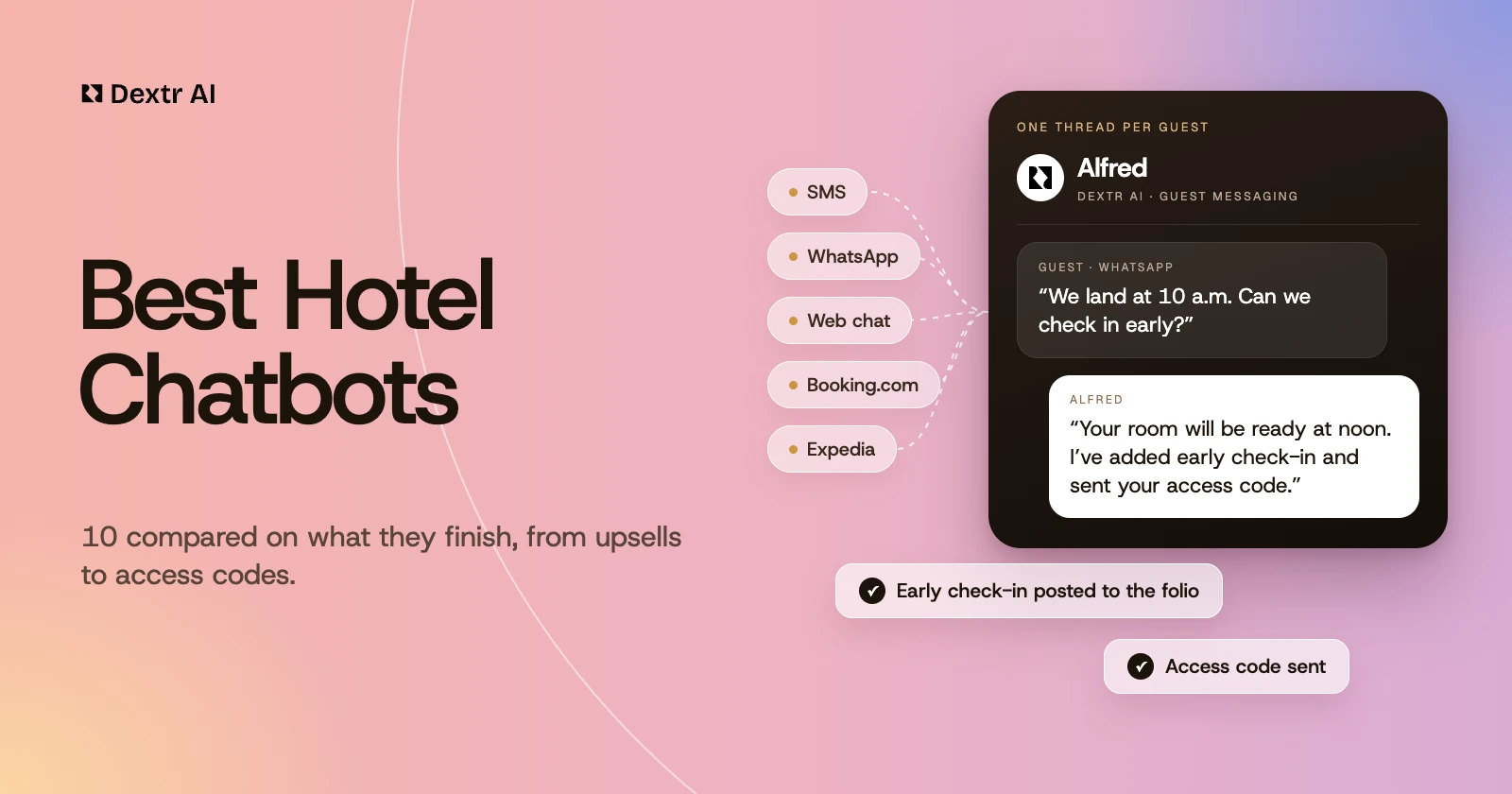
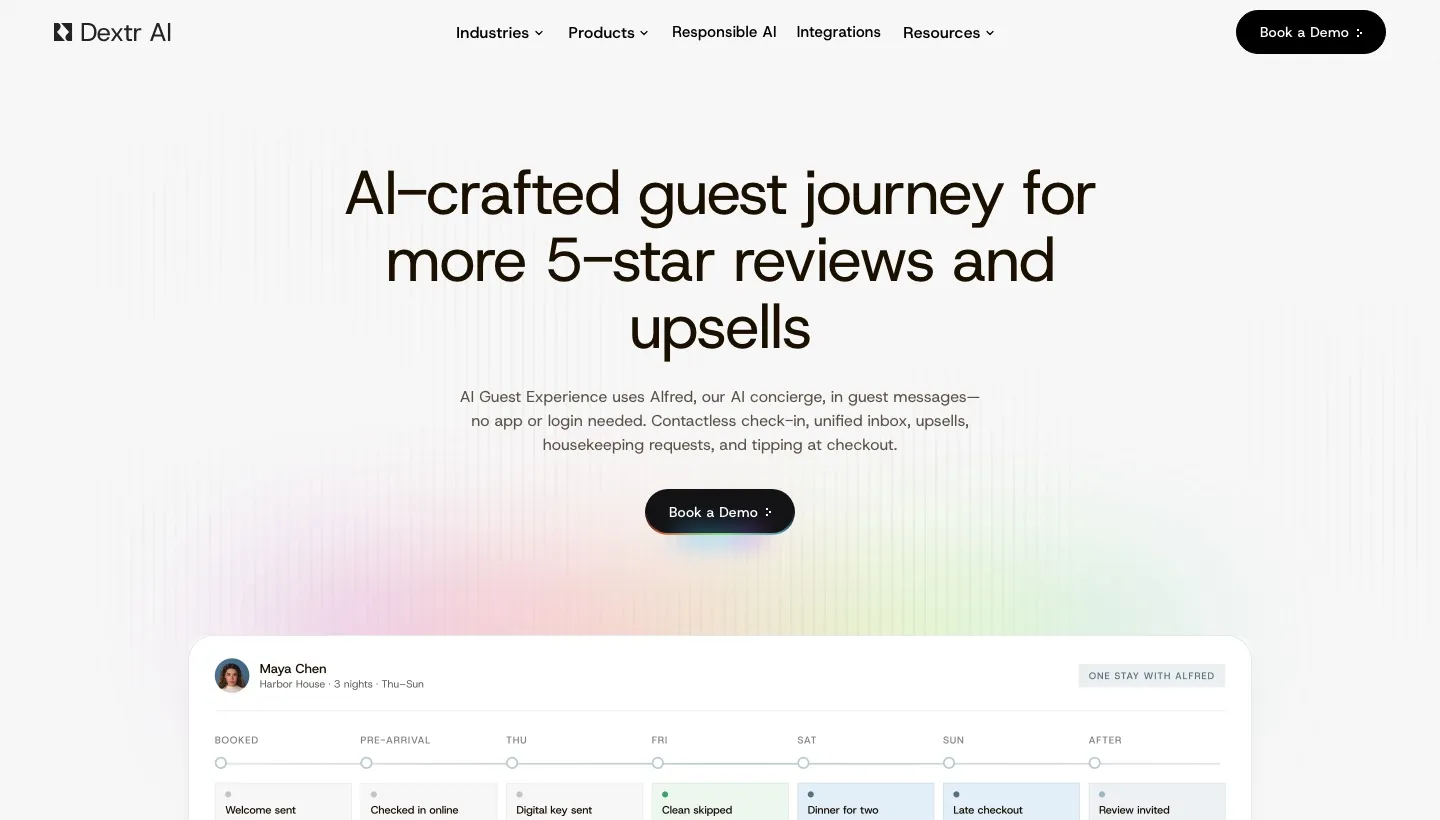
Alfred is Dextr AI’s guest messaging agent. SMS, WhatsApp, email, web chat, Booking.com and Expedia messages land in one thread per guest, and Alfred reads the reservation before it replies. It posts upsells such as early check-in to the folio, sends access codes through RemoteLock that activate and expire with the stay, collects deposits and balances by payment link, and hands anything unusual to staff with the whole conversation attached. Calls go to Daisy, Dextr AI’s voice agent, on the same guest record, and at RV parks Alfred also collects recurring fees from monthly and seasonal guests (more below).
Results: Dextr AI’s agents resolved 94% of 5,110 guest calls and texts without staff at Las Pinos Campground, 4,648 of them by text. At three California hotels, all six Booking.com and Expedia scores rose during Alfred’s pilot.
Pricing: usage-based and quoted per property, with no setup fee. Properties typically go live in seven days.
Check first: Alfred can only change what your PMS integration lets it write, so ask for a test upsell and a test access code on your own system.
2. Canary Technologies
Best for: hotels and brands that want contactless check-in, a lobby kiosk, mobile keys and AI messaging from one vendor.
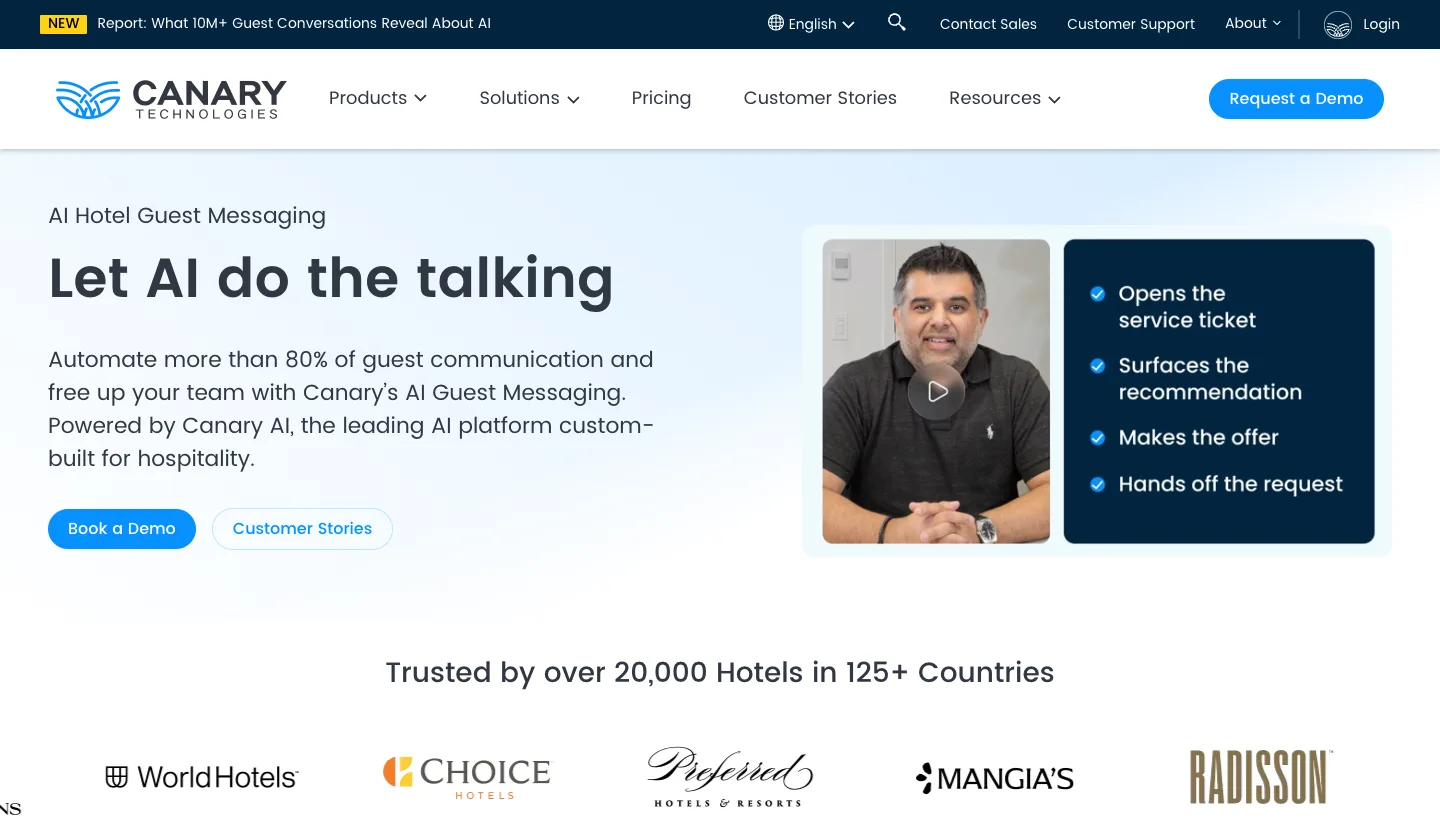
Canary’s AI guest messaging answers guest questions from a knowledge base that grows over time, translates conversations into more than 100 languages, creates service tickets from guest messages and suggests add-ons such as early check-in. Messages it can’t answer go to your team. Around it, Canary sells contactless check-in, a lobby kiosk and mobile keys, upsells, digital tipping, card authorizations, payment links, website chat and AI Voice.
Vendor-reported results: Canary says it automates more than 80% of guest communication; at the Holiday Inn Express Orlando SeaWorld it reports 82% of inquiries automated.
Works with: Opera, Mews, Cloudbeds, Stayntouch and roommaster, among other PMSs.
Pricing: quote only, in three bundles, with AI Voice priced outside all three.
Worth asking: deposits run through Payment Links, a separate product, and guest requests go to partner tools such as Quore, HotSOS and Flexkeeping. There is nothing specific to campgrounds or RV parks. See our side-by-side comparison.
3. Conduit
Best for: hotels and vacation-rental operators who want one self-serve agent across text, WhatsApp, OTA inboxes and calls, with a price on the website.
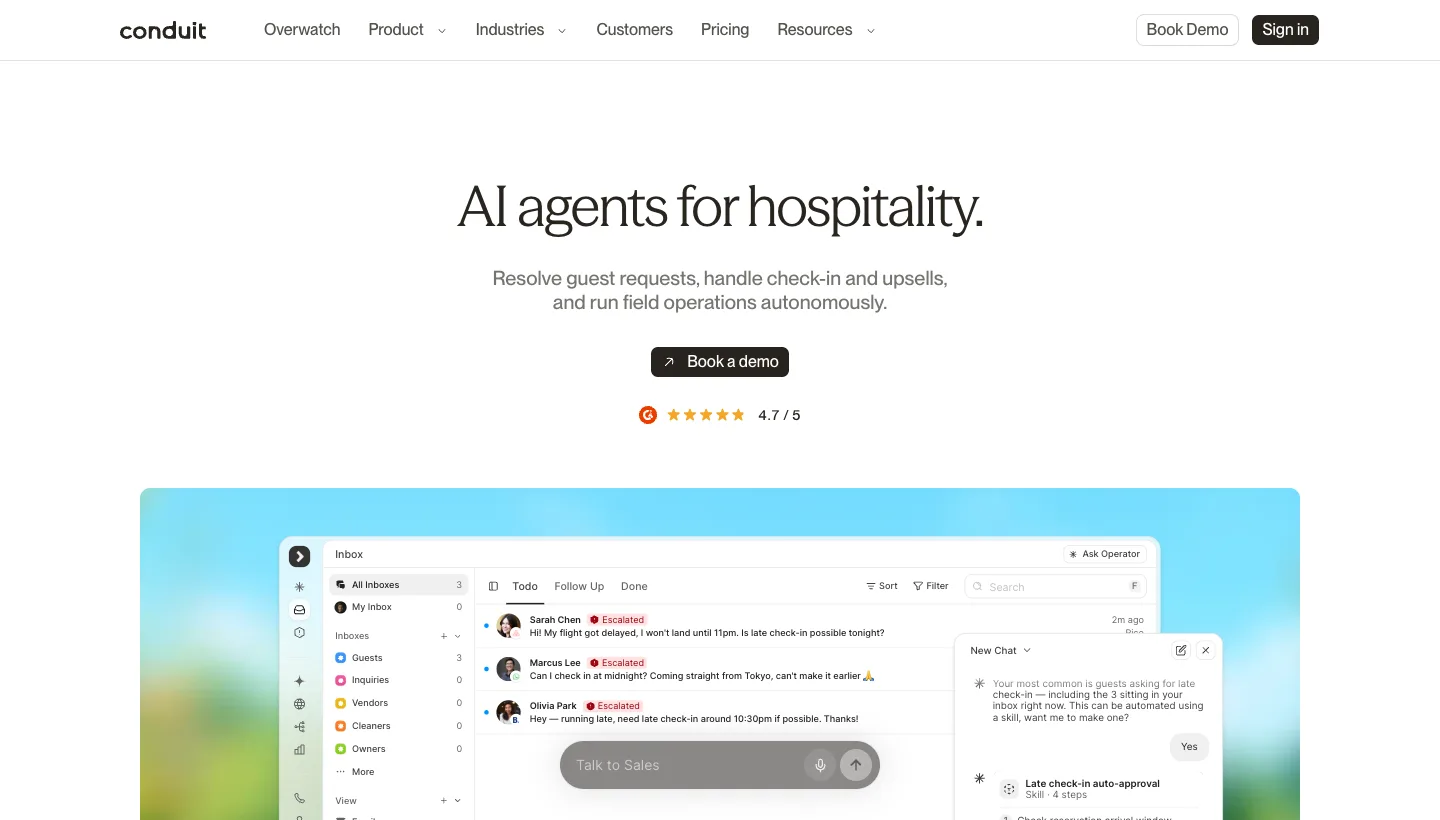
Conduit runs one AI agent across text, WhatsApp, email, website chat, social media, OTA inboxes such as Airbnb, and the phone. Conduit Portals gives each stay one link for check-in, ID checks, payments and upsells, and the agent can charge fees such as early check-in inside a message thread. Since June 2026, its voice agent can book, change reservations and reset door codes during a call. The Full Suite plan adds cleaning, maintenance and inspection tasks, and Conduit detects the guest’s language and supports 140+ languages.
Works with: OPERA Cloud, Mews, Cloudbeds, Apaleo, RMS Cloud and Stayntouch, plus Guesty, Hostaway and OwnerRez (integrations).
Pricing: $899 a month on the Startup plan; per-unit plans from $18 a unit a month, $30 with portals and upsells and $48 for the Full Suite (pricing).
Setup: Conduit says most teams go live within a week.
Check first: the plans are self-serve, so count the hours your team will spend building and maintaining workflows. Taking a booking deposit during a call isn’t a listed feature, and there is no campground or RV park offering. See our side-by-side comparison.
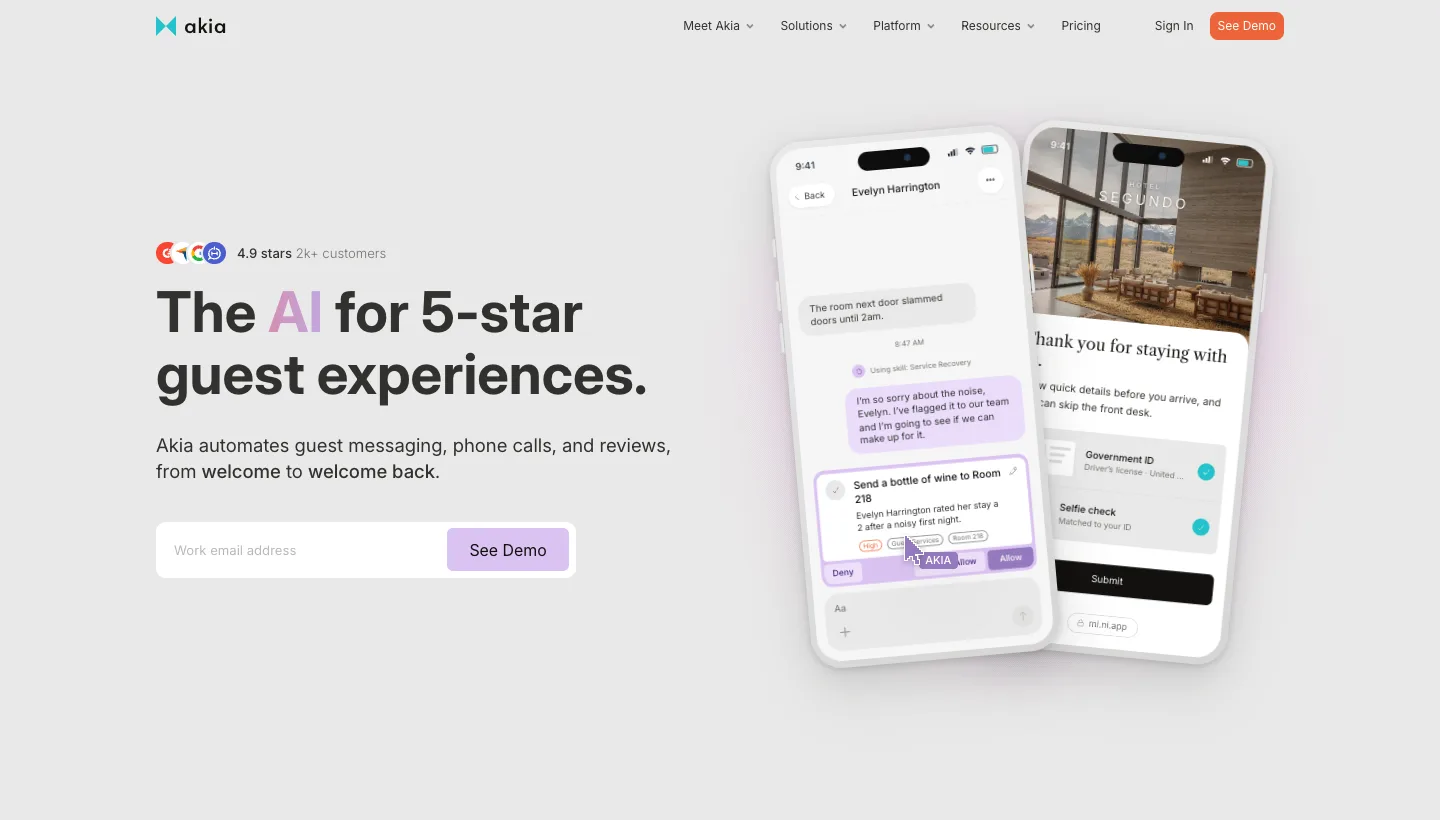
4. Akia
Best for: hotels and vacation rentals that want messaging, check-in, payments and marketing from one vendor, with voice when they’re ready for it.
Akia runs one AI agent across text, WhatsApp, email, web chat, social media, OTA inboxes such as Airbnb, Vrbo, Booking.com and Expedia, and the phone. Around the conversation it covers digital check-in with ID checks and door codes, upsells, tipping, card authorizations for stays someone else pays for, a Tasks tool for housekeeping and maintenance, and email and SMS marketing. On calls, it matches the caller to their reservation and texts a secure payment link.
Vendor-reported results: at The Chandler Hotel in Madison, Indiana, Akia reports that its AI resolves 90% of guest messages.
Works with: Opera, Mews, Cloudbeds, Stayntouch, Apaleo and Infor HMS, plus Guesty, Hostaway and Escapia.
Pricing: quote only (pricing); AI Voice sits in the top tier, Max.
Worth asking: if you’ll want the phone covered later, price the top tier now. There is no campground or RV park offering. See our side-by-side comparison.
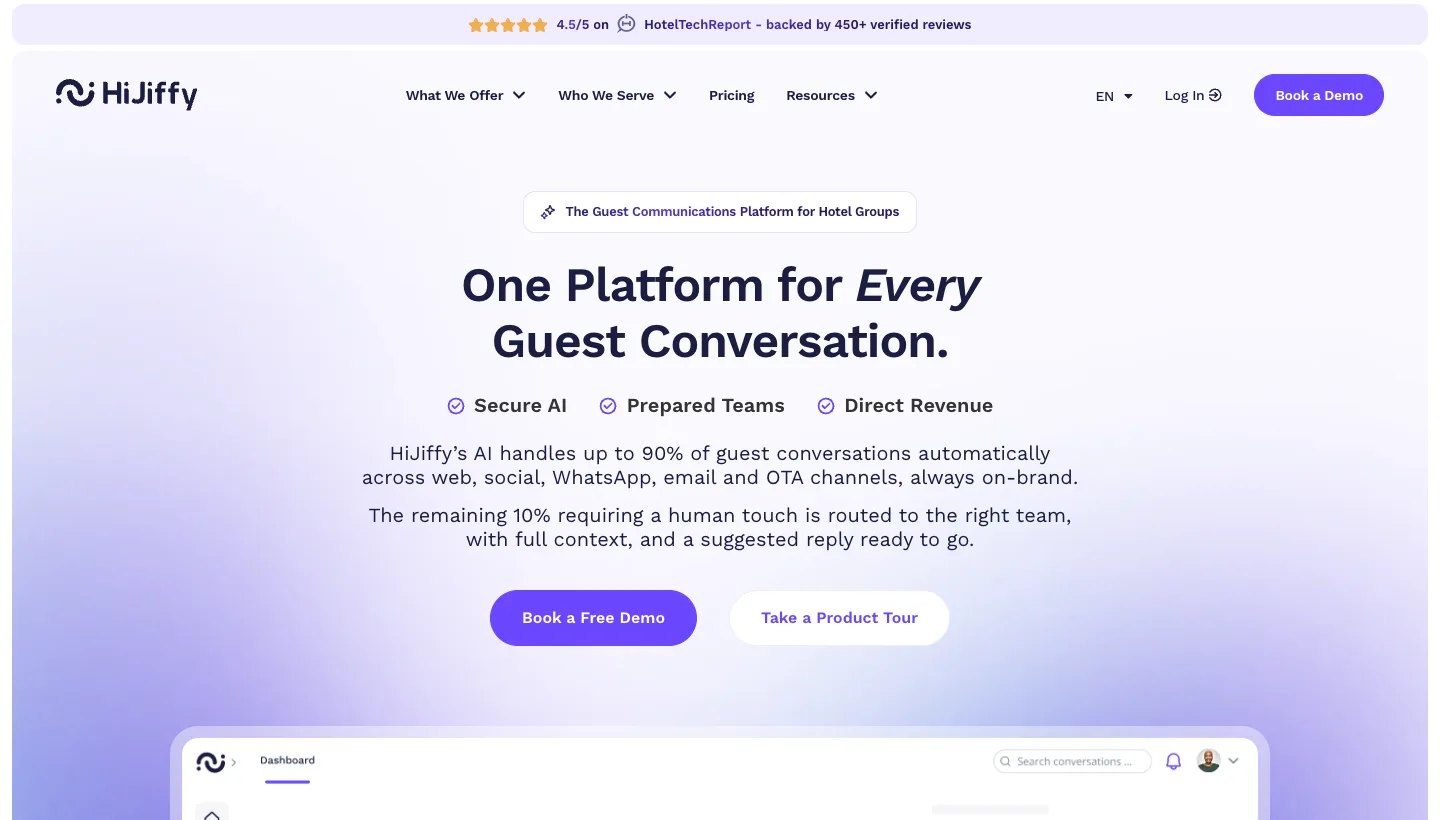
5. HiJiffy
Best for: hotel groups and resorts where most guest contact arrives in writing, across many channels and languages. It also serves glamping sites.
HiJiffy’s Booking Assistant and Virtual Concierge answer guests on web chat, WhatsApp, Instagram, Messenger, Telegram, email and the Booking.com, Expedia and Airbnb inboxes, all from one console. It quotes from your booking engine, sends check-in links and room keys by WhatsApp through your own check-in tool or key provider, and runs upsell campaigns with payment by link on supported PMSs. HiJiffy says its Aplysia 3 AI resolves up to 90% of guest conversations; that AI comes with the Pro and Premium plans.
Works with: more than 100 systems, listed on its integrations page.
Pricing: from €99 a month billed yearly for Basic, a website-only FAQ assistant capped at 25 topics and three languages. The AI Booking Assistant starts on Pro at €159, and the PMS-connected AI Digital Concierge, with WhatsApp, SMS and guest requests, is on Premium at €319. A setup fee is charged per five properties (pricing).
Check first: voice is listed as a channel, but no phone booking agent is described. Check-in and keys come from your own tools, and HiJiffy says Premium usually takes a few weeks to go live because of WhatsApp business verification and PMS access. See our side-by-side comparison.
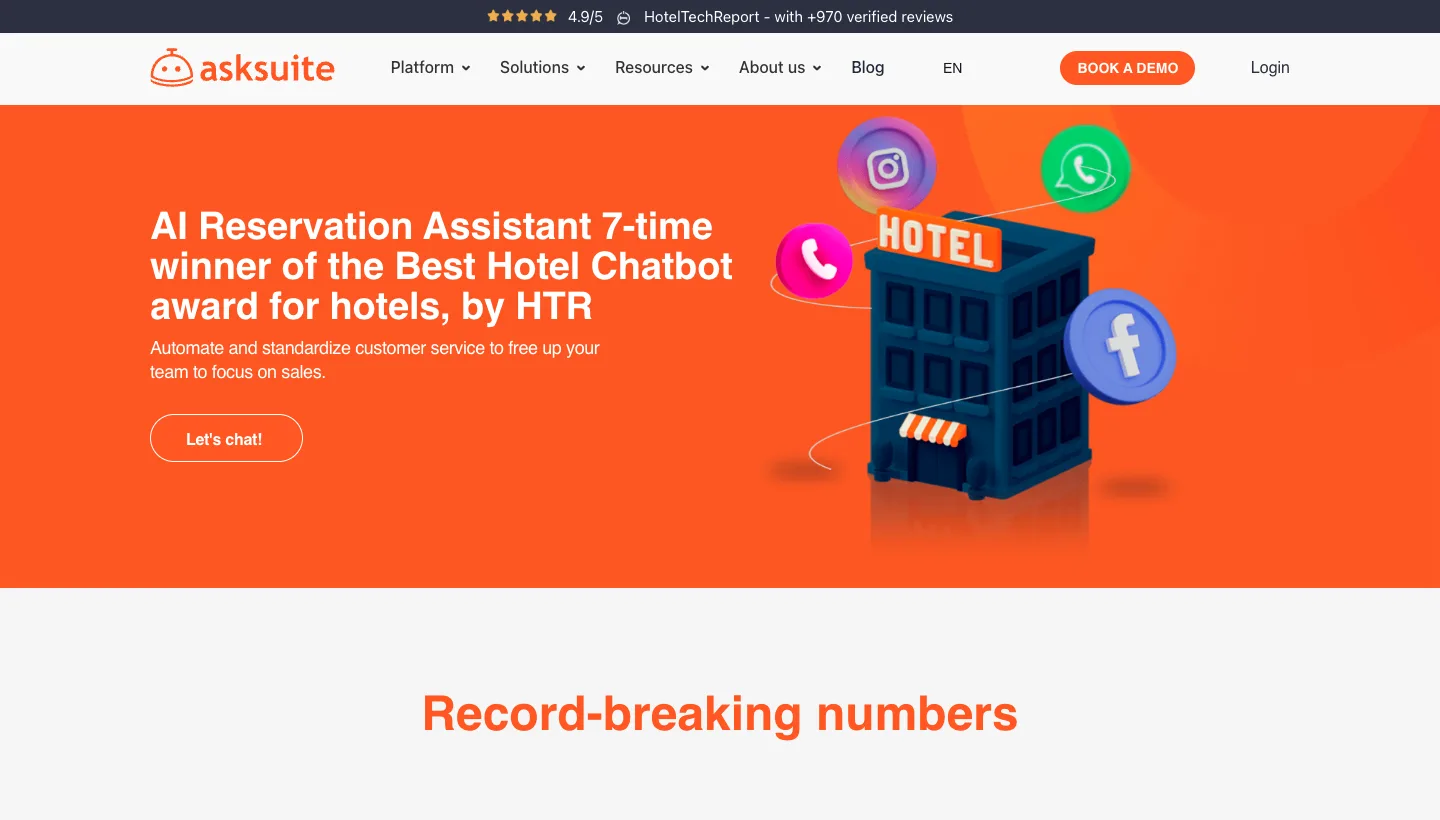
6. Asksuite
Best for: hotels and resorts that want website and WhatsApp chat to turn questions into direct bookings.
Asksuite’s AI Reservation Assistant answers by text or audio around the clock and quotes live rates and availability through connections to more than 400 booking engines. Its AskFlow agents follow up on abandoned booking-engine sessions and dropped chats, handle group quotes and send booking confirmations and check-in and check-out messages. A WhatsApp Performance Suite runs campaigns, and staff can take over any conversation from the omnichannel inbox.
Channels: web chat, WhatsApp, Instagram, Messenger and inbound email.
Scale:Asksuite says it serves more than 5,500 hotels in 80+ countries.
Pricing: quote only.
Check first: payments, upsells and phone calls aren’t listed, and its pages name no specific PMS or booking engine, so confirm yours is among the integrations before the demo.
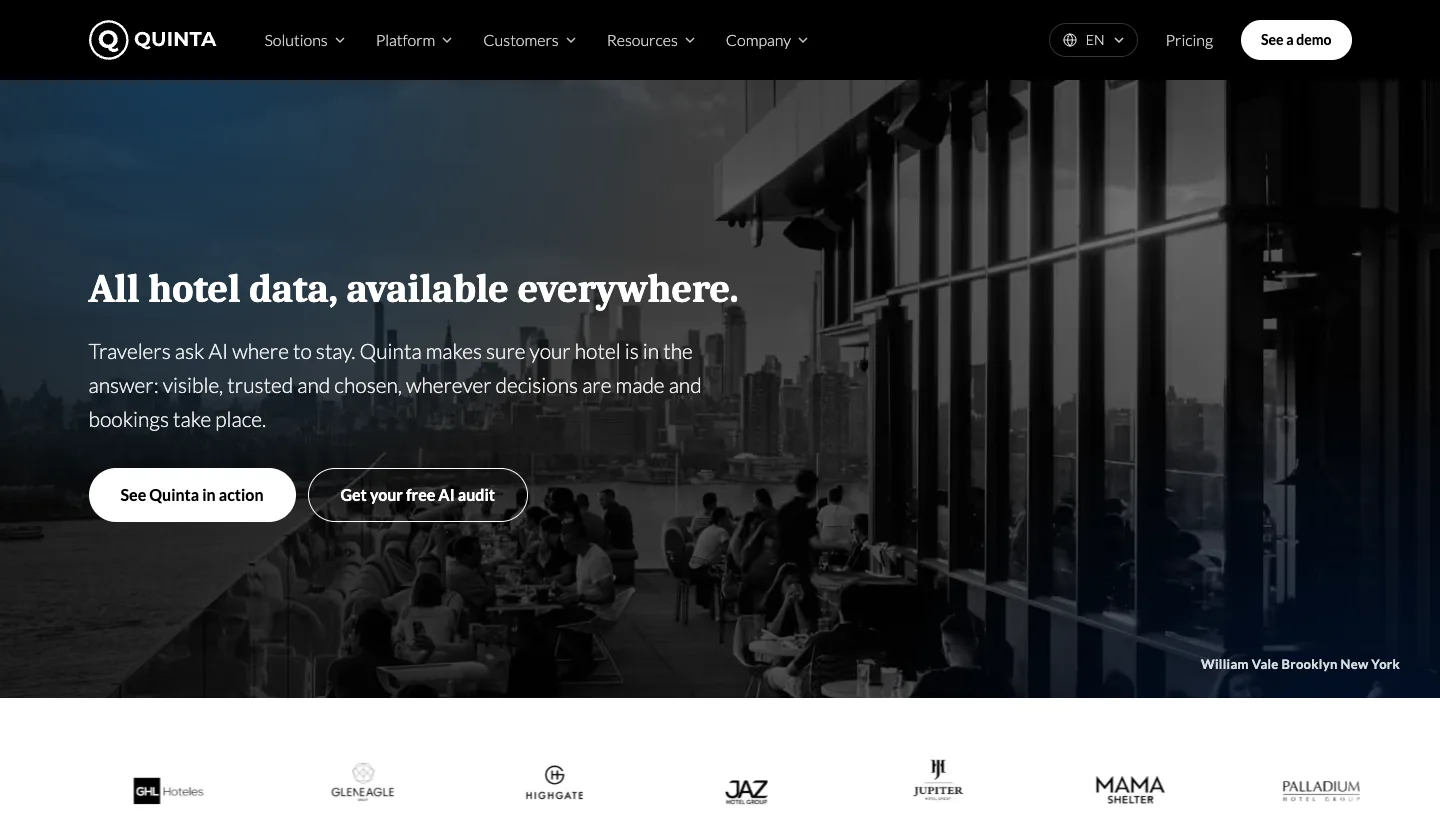
7. Quinta (formerly Quicktext)
Best for: hotel groups that want a chat assistant tied to a service that keeps their hotel data accurate across OTAs, search engines and AI assistants.
Quicktext is now Quinta. Its assistant, Velma, answers guests 24/7 before, during and after the stay on live chat, WhatsApp, Messenger and Booking.com, in 38 languages. It turns conversations into booking leads and guest requests into staff tasks through Q-Task. The rest of the company is a hotel data service: it builds a detailed profile of each hotel and distributes it to OTAs, metasearch and AI systems, with FAQs written for search engines and LLMs.
Customers named: Accor, Hyatt, Highgate, Palladium, Warwick and Mama Shelter.
Pricing: quote only.
Check first: Velma’s pages don’t mention upsells, payments, check-in or the phone, and they name no PMS, so ask what it can change in your systems, not just what it can say.
8. Duve
Best for: hotels and rentals that want the stay to run through a branded guest web app.
Duve runs the stay through a branded web app that guests open without a download: online check-in with ID scan and e-signature, digital keys in the phone wallet, upsells priced on live availability, and digital menus with mobile ordering. DuveAI answers guest messages on WhatsApp, SMS, email, in-app chat and OTA inboxes such as Airbnb and Booking.com, depending on your PMS or channel manager.
Vendor-reported results: at Sofitel Sydney Darling Harbour, Duve reports that DuveAI handles 67% of messages on its own.
Works with: more than 150 integrations, including Mews, Opera, Cloudbeds, Guesty, Apaleo and Protel.
Pricing: minimum packages from $120 a month for check-in and the guest app, $150 with messaging and $200 with upsells. DuveAI, mobile key connections and SMS and WhatsApp messages cost extra (pricing).
Check first: no agent answers the phone, so calls still reach your desk. Duve says it goes live in as little as 10 days. See our side-by-side comparison.
9. HelloShift
Best for: hotels with 40 rooms or more that want guest messaging and back-of-house tasks in one app, at a published per-room price.
HelloShift combines guest messaging with housekeeping, preventive maintenance and staff tasks. Guests text by SMS, WhatsApp or web chat and get AI replies trained on your hotel’s FAQs and documents. They check in from a link with ID checks and e-signature and receive a smart-lock code or digital key, with a kiosk for walk-ins. Its AI voice agent answers calls and walks callers through a booking, built out one PMS at a time.
Works with: more than 40 PMSs, including OPERA, Mews, Cloudbeds, WebRezPro and roommaster.
Pricing: $1.25 to $4.00 per room a month, billed annually, with a 40-room minimum. AI Voice comes in the Guest+ plan at $2.50 and the Pro plan at $4.00 (pricing).
Setup: HelloShift says most properties are running in one to two weeks.
Check first: upsells aren’t listed on its site, and voice booking depends on your PMS, so confirm both. See our side-by-side comparison.
10. Bookboost
Best for: hotel groups whose first priority is guest data, CRM journeys and marketing, with an AI agent working inside the inbox.
Bookboost puts a customer data platform, guest journeys, broadcasts and a unified inbox for WhatsApp, SMS, email, web chat, Booking.com and Expedia in one platform. Its AI agent, Bee, answers guest enquiries in several languages and escalates to your team when it needs to, and it can run in a free draft mode before you let it reply on its own. A Guest App add-on covers online check-in and check-out, a digital guide, feedback and upselling.
Works with: more than 70 PMSs, including Mews, Apaleo, Oracle Hospitality and Clock PMS.
Pricing: per room, per month: $2.60 for the required data platform and $3.30 for the inbox. Bee is free in draft mode and for its first 150 resolved conversations, then charged per room at a rate that isn’t published. The minimum is US$465 (€399) a month (pricing).
Check first: door locks are marked “coming soon,” and payments and phone calls aren’t listed.
Key takeaway
If guests mostly ask questions, several of these will do. If you want the chatbot to sell, unlock and collect without staff, the shortlist gets short quickly: ask each vendor to show all three on your own PMS.
Others Worth a Look
Myma.ai: a voice agent, website chat and one guest inbox from a single platform, for hotels, resorts and holiday parks. Custom quote. See our side-by-side comparison.
INTELITY: in-room tablets, a branded app and mobile keys, with an AI concierge that answers on mobile, tablets and voice devices. A fit for resorts and casinos that want in-room hardware. See our side-by-side comparison.
Kipsu: a texting inbox your own team answers, with a sister product for tickets and housekeeping. Right if you want a person behind every reply. See our side-by-side comparison.
General-purpose chatbot platforms such as Intercom, Zendesk and HubSpot have strong inboxes and reporting, but they don’t know your reservations until someone builds the PMS connection, and hotel jobs like folio charges and access codes become custom work. They make sense mainly for groups that already run one and have developers.
What I’ve Learned From Dextr’s Own Chatbot Deployments
Vendor pages, ours included, describe what a chatbot can do. Deployment data shows what guests actually do with it. These lessons come from Dextr AI’s published case studies, and they’re why I judge chatbots on more than a feature list.
Guests would rather text, once they know they can
When Dextr’s agents went live at Las Pinos Campground, a river-front property with one or two people at the desk, phone calls were nearly half of all guest contact early in the rollout. By July, the campground handled 1,582 conversations in that single month, nearly all by text, with the same team. Over five and a half months, Alfred carried 4,648 text conversations, against 462 calls answered by the voice agent. Size the chatbot for the volume you’ll have once guests find it, not the inbox you have today.
A specific offer beats a menu of upsells
In our three-hotel pilot, Alfred offered early check-in to every arriving guest by text. One guest asked to arrive at 12:30 and asked for a specific room. Alfred checked with the manager, came back with the earliest slot, 1:30 p.m. for $10, and sent a payment link to secure it within 15 minutes. When a rewards member asked the same question, the manager waived the fee, and Alfred confirmed the free early check-in. Same offer, two outcomes, no phone call either way. That’s the pattern I look for in any demo: checked against what’s actually available, priced, and paid inside the thread.
The most valuable question is often one nobody asks
Most short-stay guests don’t need their room cleaned every day; they’ve just never been asked. Across six California hotels, Alfred texted guests during their stay to ask. 70% of the guests who answered chose to skip a clean, and the hotels saved 1,200 housekeeping hours. A chatbot that only waits for questions misses work like this.
Knowing when to stop answering is a feature
Guests at Las Pinos come for the river, and Alfred answers questions about depth and conditions from what the campground taught it. The campground also set the opposite rule: during an active flood, the AI stops answering river questions and sends each one to the front desk for a real-time update. When the Brazos rose over the road in July 2026, guests asking whether the campground was open got a person, not a guess, and one broadcast reached 50 to 100 guests at once with alternate routes and hold-in-place guidance. A chatbot that answers everything confidently is a liability. Ask every vendor how fast you can switch a topic from “answer” to “escalate.”
Staff trust the bot when the handoff is easy
At Las Pinos, conversations stream to a private staff channel, and a manager steps in with one reply; the AI pauses with the full history and resumes when they step back. The owner put it this way: “Danny and Alfred will handle the remainder of the conversation. We just chime in when needed.” (Danny is the name the campground gave its voice agent.) At Eli’s Retreat RV Park, where the two owners run everything themselves, the AI escalated 415 of 1,419 conversations, and before each one it had already captured the guest’s name, dates and request. The most common reason, 192 times, was custom and extended-stay pricing, exactly the kind of decision that should stay with a person.
Service recovery happens in the thread, before the review
In the same three-hotel pilot, Alfred checked in with guests during and after their stay. When a guest reported a problem, such as a room with no hot water or a charge for an extra night, Alfred passed it to management before it could turn into a public review. All six Booking.com and Expedia scores across the three hotels rose during the pilot; the Leland Hotel in Palo Alto went from 7.8 to 8.2 on Expedia. For more on where AI helps the guest experience, see our guide to AI for hotels.
Key takeaway
The chatbots that pay for themselves do three things a FAQ bot can’t: they start conversations (offers, housekeeping questions, check-ins after a stay), they know when to stop, and they hand off cleanly.
Hotel Chatbots at Campgrounds and RV Parks
Most chatbots on this list are built around hotel rooms. Campgrounds and RV parks sell sites, and their guests ask about rig lengths, hookups, pet rules by site type and how to get in after the office closes. Of the ten, only Dextr AI lists a dedicated offering for campgrounds and RV parks, with direct connections to park systems such as ResNexus and RMS Cloud; HiJiffy serves glamping sites, and Myma, listed above, serves holiday parks. The jobs that pay are the same as at a hotel, with a twist:
Upsells. Hotels sell early check-in and upgrades; parks sell add-ons and longer stays. Alfred sends context-aware add-ons with one-click purchase links, the same way it offers early check-in and late checkout at a hotel.
Access management. Late arrivals are normal at parks. With a connected lock or access system, Alfred sends the access code before arrival, the code activates and expires with the stay through RemoteLock, and Alfred resends the details when a guest can’t get in, with anything unusual passed to a person.
Recurring fees from long-term guests. Many RV parks mix overnight travelers with monthly and seasonal guests. For those long-term guests, Alfred collects the recurring fee by text: it sends the amount due with a secure payment link and follows up with reminders, so nobody in the office spends the first week of the month chasing site fees by phone. Custom long-stay pricing and anything about tenancy rules stays with a manager.
The results carry over too. At Las Pinos, 94% of 5,110 guest interactions were resolved without staff, and at Eli’s Retreat, revenue grew 34% year over year with the voice agent taking more than $9,474 by phone. For the full playbooks, see our guides to AI for campgrounds and AI for RV parks.
Key takeaway
For a park, the reservation system decides it. Confirm the chatbot can see a real site booking in your software before anything else.
What Hotel Chatbots Cost in 2026
Five of the ten publish prices, each in a different unit, so convert every quote into a monthly total for your property:
Chatbot
Published price
What changes the bill
Conduit
$899 a month (Startup), or $18–$48 per unit a month
Plan and credits; per-unit plans add portals, upsells and tasks
HiJiffy
From €99 a month billed yearly; Pro €159, Premium €319
Room count, plan and a setup fee per five properties
Duve
From $120 a month; $150 with messaging, $200 with upsells
DuveAI, key connections, SMS and WhatsApp messages cost extra
HelloShift
$1.25–$4.00 per room a month, billed annually
40-room minimum; AI Voice in the $2.50 and $4.00 plans
Bookboost
Per room: $2.60 data platform plus $3.30 inbox
Bee’s per-room fee after 150 resolved conversations; US$465 monthly minimum
Dextr AI, Canary, Akia, Asksuite, Quinta
Quote only
Dextr AI: usage-based, free knowledge answers, no setup fee
As a worked example, a 100-room hotel would pay $250 a month for HelloShift’s Guest+ plan, billed annually, and about $590 a month for Bookboost’s data platform and inbox before Bee’s fee. When you compare quotes, ask what counts as a conversation, whether WhatsApp and SMS fees are passed through, whether setup and the PMS connection are included, and who builds the workflows.
Key takeaway
Price a chatbot against the work it removes: the upsells it sells, the calls it heads off and the staff hours it saves. Message counts tell you very little.
Questions to Ask in Any Hotel Chatbot Demo
A guest asks for early check-in. Can you post the fee to the folio in my PMS while I watch?
What does the chatbot know about this guest: room, dates, balance, past stays?
Send an access code for a test reservation. What happens when the guest says it doesn’t work?
Send a payment link for a balance. Where does the token land, and who stores the card?
Which channels share one thread: SMS, WhatsApp, web chat, Booking.com, Expedia, email? What about calls?
Hand this conversation to a person. What does my team see, how do they take over, and does the AI pick up again afterwards?
What share of conversations do you finish without staff at properties my size, and which ones still reach a person?
How do I change a policy or switch a topic to “escalate only,” and how soon does the chatbot follow it?
Who builds and maintains the workflows, your team or mine, and is there a setup fee?
What exactly will I pay each month, and what counts as a conversation?
If you want a chatbot that answers, there are ten good options here. If you want one that finishes the work, posting the upsell, sending the access code, collecting the payment and handing your team only the cases that need a person, that’s what we built Alfred to do, alongside Dextr AI’s agents for calls, housekeeping and marketing. You’re live in seven days, there’s no setup fee, and the pilot runs on your toughest property.
Frequently Asked Questions
What is the best hotel chatbot?
It depends on what you want it to finish. For hotels, campgrounds and RV parks that want upsells posted to the folio, access codes sent and payments collected in the same thread, Dextr AI’s Alfred is the pick, and it works alongside Dextr AI’s agents for calls and housekeeping. Canary suits hotels that want a kiosk and mobile keys from the same vendor, Conduit suits teams that want a self-serve agent with a published price, Asksuite and HiJiffy suit hotels focused on website and WhatsApp bookings, Duve suits a branded guest app, HelloShift suits hotels that want staff tasks in the same app, and Bookboost suits CRM-led groups.
What does a hotel chatbot do?
It answers guests in writing at any hour, on the hotel’s website, by SMS, on WhatsApp and in OTA inboxes. Basic chatbots answer questions from a knowledge base. The better ones read the reservation and act on it: they sell and post upsells, run check-in, send access codes, collect payments and pass requests to staff with the conversation attached.
How much does a hotel chatbot cost?
Published entry prices start at about €99 a month (HiJiffy’s website-only plan) and $120 a month (Duve, before its AI), and Conduit’s Startup plan is $899 a month. HelloShift charges $1.25 to $4.00 per room a month with a 40-room minimum, and Bookboost charges per room with a US$465 monthly minimum. Dextr AI, Canary, Akia, Asksuite and Quinta quote on request; Dextr AI is usage-based with no setup fee.
Can a hotel chatbot take bookings and payments?
Yes, if it connects to your booking engine or PMS and your payment processor. Ask to see a booking or a charge land in your own system during the demo. Dextr AI’s Alfred sends secure payment links in the same thread, and tokenization is handled by your payment processor, so card numbers never sit in the chat.
Which hotel chatbot works on WhatsApp with Cloudbeds?
Dextr AI’s Alfred answers WhatsApp messages and connects to Cloudbeds through a live integration, along with Mews, OPERA Cloud, Stayntouch and other PMSs. Conduit, Akia, Duve and HelloShift also list both WhatsApp and Cloudbeds.
Can a hotel chatbot send door codes or digital keys?
Yes, when it connects to a lock or access platform. Dextr AI’s Alfred sends digital keys and access codes through RemoteLock and supported locks, with codes that activate and expire with the stay. Akia, HelloShift and Duve also list door codes or digital keys, Canary sells mobile keys, Conduit resets door codes on calls, and HiJiffy sends keys from your own key provider. Our guide to automating a hotel covers keyless entry in more detail.
What is the difference between a hotel chatbot and an AI agent?
A chatbot answers; an AI agent finishes the task in your systems. The quick test is what has changed when the conversation ends: if only the guest got a reply, it was a chatbot; if the reservation, the folio or the housekeeping board changed too, it was an agent. Our guide to AI agents versus chatbots covers the difference in detail.
Will guests know they are chatting with an AI?
They should if they ask. Set the chatbot to say it’s an AI when asked and make it easy to reach a person at any point. Disclosure rules vary by state and country, so check yours before you go live.
Do hotel chatbots work for campgrounds and RV parks?
Most are built for hotel rooms. Dextr AI has a dedicated offering for campgrounds and RV parks: Alfred answers site questions, sends add-ons with purchase links and access codes for late arrivals, and at RV parks collects recurring fees from monthly and seasonal guests by text. It connects to park systems such as ResNexus and RMS Cloud.
How long does it take to set up a hotel chatbot?
From a few days to a few weeks. Dextr AI goes live in seven days per property and builds the workflows for you. Conduit says most teams go live within a week, Duve in as little as 10 days and HelloShift in one to two weeks, while HiJiffy’s Premium plan usually takes a few weeks because of WhatsApp verification and PMS access.
Growth and search specialist with hands-on experience in the AI sector. Covers AI agents, voice AI and automation, and how businesses evaluate and adopt them.
Conduit puts guest messages and calls on one AI agent with prices on its website. Hotels look elsewhere when they want the deposit taken on the call, the workflows built for them, Booking.com messages covered today or the back of house run by agents. Eleven alternatives compared, with prices and lessons from real deployments.
Nine HelloShift alternatives compared on four questions: does the call end with a deposit taken, which inboxes does the AI answer, what does a hotel under 40 rooms pay, and who runs housekeeping? With prices for a 20-room inn and a 60-room hotel.
Eleven property management systems, picked by the kind of property each one suits, from hotel groups and resorts to B&Bs, RV parks and vacation rentals, with prices where they're public and what to check first. Plus entry 0: the AI layer that works inside all of them.
Deepak Sharma · Read article
Ready to grow your business?
×
The demo scheduler is provided by HubSpot and uses functional cookies. Allow functional cookies to book a time here, open the scheduler on HubSpot's site, or use the Inquiry tab.