
AI for Hotels: 7 Ways to Improve Guest Experience
Seven ways AI can shorten the wait between a guest’s request and your team’s response, from the first inquiry to the post-stay follow-up, with the metrics to track and the decisions staff should keep.

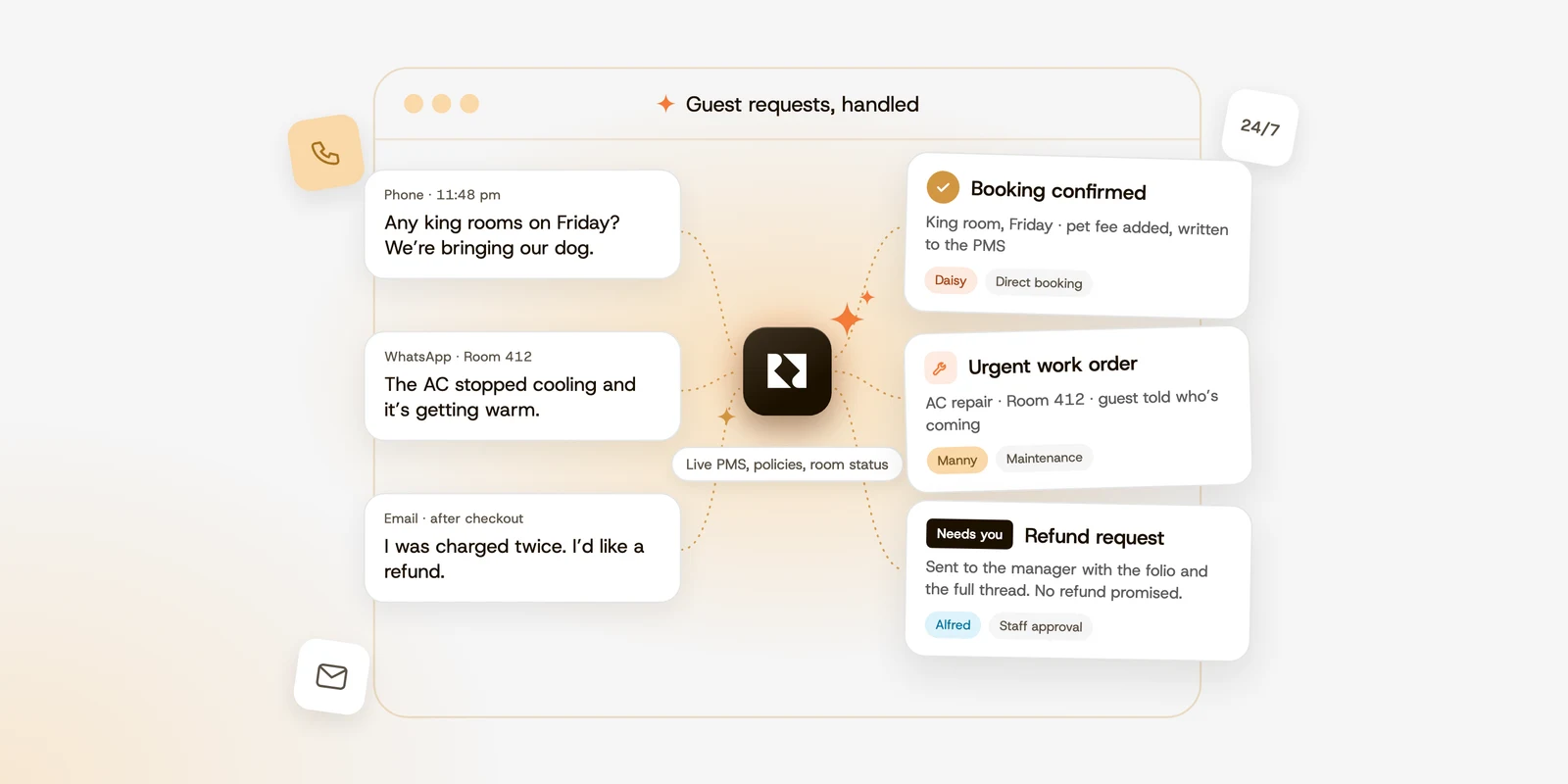
When a guest asks about a room after hours or reports a broken AC, a slow response can cost a booking or leave a problem unresolved. AI for hotels can close that gap by answering inquiries, completing reservations, and routing service requests to the right team.
AI platforms for hotels such as Dextr AI connect guest conversations with property workflows, so a request can move beyond a reply to an approved action or staff handoff. Staff remain available for guests who need a person; the AI needs live property data, clear permissions, and reliable escalation to help them.
Key takeaways
- AI for hotels answers guest inquiries, completes reservations and routes service requests around the clock, across phone, text, web chat and email.
- It works only when connected to live property data, such as the PMS, rates and room status, with clear permissions and a reliable handoff to staff.
- The seven main uses are bookings, check-in, personalized offers, housekeeping, maintenance, pricing and staffing, and post-stay follow-up.
- Staff should keep control of refunds, safety decisions, pricing approvals and other exceptions.
- Guests want AI help, not full automation: 78% of travelers want to use AI during their accommodation journey, but only 12% want machines to run every hotel function (SiteMinder, 2025).
- Start with one bottleneck, such as after-hours reservation inquiries, and measure completed bookings and resolved requests, not the number of replies.
What AI for Hotels Actually Does
Hotel AI includes conversational assistants, forecasting systems that recommend rates, and workflow tools that assign tasks. A basic FAQ bot replies from a fixed set of answers. AI agents for hotels connected to a property management system (PMS) can look up availability or room status. With the right permissions, they can carry a request through to completion. Neither should make up policies or promise an unapproved refund.
| Operational need | Useful AI action | Staff should retain control of |
|---|---|---|
| Guest wants a room after hours | Answer policy questions and move an eligible request toward a direct reservation | Exceptions, disputed charges, special concessions |
| Guest needs an early room | Read current room status and pass the request to the right team | Promising access before a room is ready |
| Guest reports a problem | Create and prioritize a service ticket | Safety decisions and sensitive recovery conversations |
| Demand changes | Recommend rates from booking pace and available inventory | Pricing limits and final approval where required |
Ask whether the system can complete and record the next step, then alert a person when it cannot.

SiteMinder’s survey of more than 12,000 travelers across 14 markets found that guests want help from AI without surrendering every part of the stay to machines:
Survey finding
“78% globally want to use AI at some point during their accommodation journey,” while “only one-in-ten (12%) want machines to manage all hotel functions.”
7 Ways to Improve the Guest Experience With AI
1. Answer Inquiries and Capture Bookings Around the Clock
A traveler calls at night to ask about pets and parking. An assistant uses the property’s current rules, checks availability, and helps the guest book direct. If staff need to step in, it passes along the conversation. A bot that says “contact the front desk” leaves the team with the same work.
Start with questions your reservation team hears often: arrival times, cancellation rules, accessibility, fees, amenities, and room differences. Connect the assistant to the reservation source before allowing it to quote inventory or rates. Across voice, text, web chat, and email, guests need consistent answers and a handoff that preserves the conversation.
Track inquiry-to-booking conversion, missed calls or messages, response time, and direct-booking share. Dextr AI’s agents handle reservations and guest inquiries across those four channels, a useful starting point for teams losing demand outside staffed hours.
For a closer look at handling spoken inquiries, see AI voice agents for hotels.
2. Make Check-In and Arrival Less Stressful
Guests should know about parking, payment, and room readiness before they reach the desk. AI can send arrival instructions, answer check-in questions, and relay an early-arrival request. A current PMS connection gives staff information to act on without promising a room before it is ready.
Map the handoff before automating: which requests can receive an immediate answer, which depend on room status, and which require a manager? If your property needs identity or payment verification, keep those steps inside approved systems rather than collecting sensitive details in an open chat.
To see whether arrival has improved, compare time spent on routine questions, check-in waits, and early-arrival requests resolved before guests reach the desk.
3. Personalize Stays and Offer Relevant Extras
A returning guest who booked a quiet room has different needs from someone attending a conference. With permission to use booking and preference data, AI can help staff tailor a recommendation or offer an upgrade or late checkout when inventory allows.
Keep the offer grounded in what the guest has asked for. A family asking about adjoining rooms might welcome a room option; a guest reporting a noisy neighbor should get help, not a sales pitch. Set offer eligibility, timing, and price rules in advance, and allow staff to override suggestions.
Accepted upgrades and ancillary revenue per stay show whether the offers work. Watch opt-outs and complaints about irrelevant messages too; a wrong guest profile can spoil an otherwise useful offer.
4. Coordinate Housekeeping Around Real Arrivals
The front desk sees an early arrival while housekeeping sees a list of rooms. A shared queue can combine checkouts, room status, arrival times, and requests. Housekeepers can prioritize the room a guest needs and adjust the order when a room needs extra work.
For a resort or campground, the same idea applies to units, sites, and amenities: send the right task to the right team with the location and request attached. Do not mark a space ready just because an expected cleaning window has elapsed. Require a real status update from the team or system of record.
Room-ready time, guest wait time, task completion lag, and repeat dispatches tell you whether coordination improved. Dextr AI supports check-in and housekeeping workflows, connecting the guest request to the team’s follow-through.
The same coordination principle applies to AI-powered property operations.
5. Catch Maintenance Issues and Recover Service Quickly
Suppose a guest texts that the air conditioner stopped cooling. The team needs to acknowledge the guest and create a work order with the room, urgency, and context. Safety concerns or an unavailable room move call for escalation, not an improvised resolution.
AI can group repeated temperature complaints from the same wing so a manager spots a pattern. Predictive maintenance needs more data: equipment history or sensors may signal trouble before a failure. Without that data, software has little to go on.
Measure time to acknowledge, time to resolution, repeat complaints, and reopened work orders. Assign a person to each unresolved case. A ticket can exist for hours without anyone helping the guest.
6. Use Demand Forecasts to Improve Pricing and Staffing
Revenue management AI can combine booking pace, seasonality, available inventory, and demand signals to recommend rate changes. A busier weekend may justify a higher rate; a softer midweek period may need a different offer. The same forecast can inform front-desk and housekeeping coverage, so a pricing decision does not leave arriving guests in a long queue.
Pilot recommendations on a limited set of dates or room types. Establish rate floors, ceilings, blackout periods, and approval ownership. Keep group commitments and special contracts out of an automated repricing path unless the rules explicitly account for them. This use improves the guest experience indirectly: better staffing and availability decisions reduce friction while protecting property revenue.
Judge the pilot by revenue per available room (RevPAR), average daily rate, occupancy, forecast error, and labor hours relative to arrivals. A higher rate means little if the property loses too many bookings.
7. Turn Post-Stay Feedback Into Repeat Stays
After checkout, AI can sort feedback into praise, unresolved problems, and requests for follow-up. It can draft a response and identify guests who may welcome a return offer. Staff should approve sensitive replies and close open service issues before sending marketing messages.
If a guest complained about noise and staff fixed it during the stay, acknowledge the experience in the follow-up. A generic “perfect stay” email would miss the point. Use consent and communication preferences to decide who receives direct marketing. Dextr AI supports service recovery, direct marketing, and repeat-booking workflows, so the team can account for the complaint before sending the next invitation.
Keep an eye on unresolved issues after checkout, response time to feedback, repeat-booking rate, and unsubscribes.
What a Completed Guest Request Looks Like
An arriving guest texts that they will be early and need a place to work. The check-in policy is part of the answer. The team also needs to decide whether a room can be made ready and where the guest can go in the meantime:
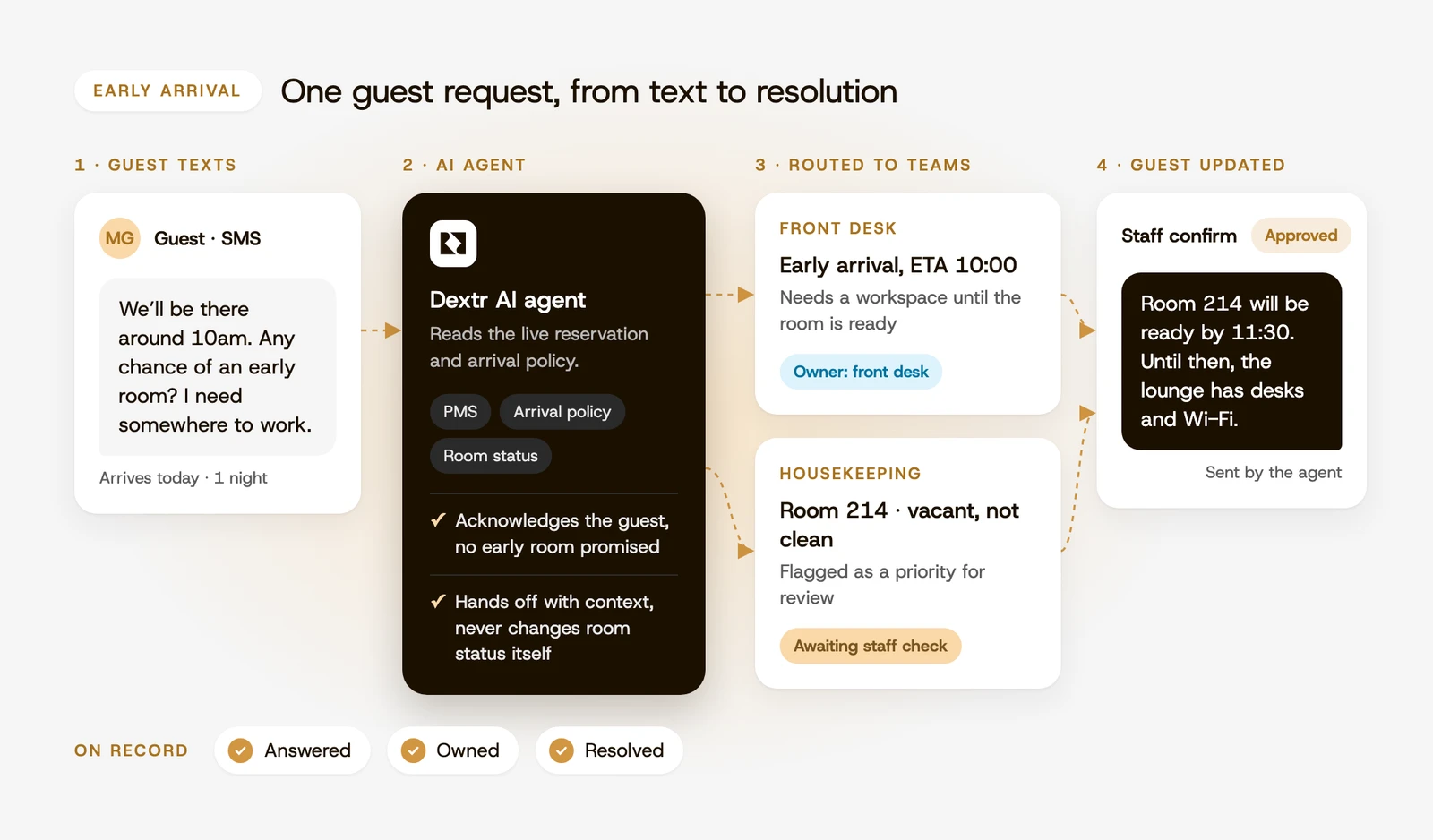
The assistant reads the current arrival policy and reservation, then acknowledges the request without guaranteeing early access.
It passes the request and expected arrival time to the front desk. If a room is vacant but not clean, it creates a housekeeping priority for review instead of changing room status itself.
Staff confirm whether a room is ready. The assistant can send the approved response, such as directions to a lounge or confirmation that the room is available.
If no room can be readied, the guest receives a useful alternative and a clear next update, not a silent “pending” ticket.
The property can now see whether someone answered the guest, took ownership, and resolved the request. That record is more useful than a polished greeting. Late checkout, accessible-room questions, and maintenance problems need similar handoffs, each with its own decision rules.
How to Roll Out Hotel AI Without Creating More Work
Pick one workflow with a visible bottleneck. After-hours reservation inquiries are often easier to pilot than multiple departments at once. Record the starting value for the metric you care about. Then decide what counts as a completed task, a handoff, or a failure.
- Map the source of truth.
Identify where live rates, inventory, room status, policies, guest preferences, and payments live. Give the AI only the access it needs for its assigned task.
- Set action boundaries.
List what it may answer, book, update, or route; define when it must ask a person. Test edge cases such as a sold-out date, an accessibility request, a refund dispute, and a safety complaint.
- Train the team on handoffs.
Make ownership visible. A staff member receiving an escalation should see the guest’s request, what the AI already did, and what still needs doing.
- Review outcomes, not conversation volume.
Count completed reservations, resolved requests, response times, errors, and guest complaints. Compare with the baseline, then expand to the next workflow if the results hold.
Hotels and RV parks run on different procedures. Dextr AI can be configured for each property’s rules and brand standards, connects with property management and payment systems, and provides hands-on onboarding. Staff and owners can use its DOSS assistant to ask about property information and coordinate workflows in natural language. That can mean less rekeying and fewer requests left between teams.

Choose the Right System for the Job
“AI for hotels” covers different products. A revenue management system recommends rates; a guest-messaging assistant answers questions; an operations agent routes or completes work. One product may not handle all three jobs. Match your first purchase to a measurable bottleneck.
| If the main problem is… | Prioritize… | Ask for a live demonstration of… |
|---|---|---|
| Missed reservation calls and messages | Connected voice and digital reservation handling | A date change, sold-out night, and direct-booking handoff |
| Front-desk interruptions | Guest messaging plus current property knowledge | A policy answer followed by a human escalation with the transcript |
| Rooms not ready when arrivals reach the desk | PMS-connected task routing | An early-arrival request that updates staff without falsely marking a room ready |
| Slow response to problems | Maintenance routing and service recovery | A complaint that reaches an owner, is resolved, and is reflected in the guest follow-up |
| Inconsistent rate decisions | Forecasting and pricing controls | A demand shift with a rate recommendation inside approved limits |
Use scenarios from your property in the demonstration. Give a reservation tool an exception it cannot book on its own. Ask a service tool what the guest hears if staff do not accept an escalation. For pricing, show who can approve or reverse a recommendation. These cases reveal whether the product fits your team’s work.
Compare the cost of the tool and onboarding with the result you need: recovered bookings, staff time saved, or faster resolution. If an employee still has to finish every request, counting automated replies as labor savings will mislead you.
Where Dextr AI Fits Among Hotel AI Tools
Dextr AI is an AI workforce for hotels, resorts, vacation rentals, campgrounds, and RV parks that need to respond to more guest demand without adding staff in proportion. Its agents handle reservation inquiries across calls, texts, web chat, and email, including after-hours questions and direct-booking opportunities. They also support check-in, housekeeping, maintenance, service recovery, upsells, and repeat-booking workflows. Unlike a standalone FAQ chatbot or rate-recommendation tool, Dextr focuses on moving a guest request from conversation to the next approved action or staff handoff.
For an evaluation, ask Dextr to demonstrate a real reservation inquiry, a service issue that needs escalation, and the resulting record in your property systems. Its agents connect with property management and payment systems, follow property-specific procedures and brand standards, and are supported by hands-on onboarding. Staff and owners can use DOSS to query property information and coordinate follow-through. Compare completed bookings, unresolved requests, response times, and labor hours against your baseline rather than treating every automated reply as a completed task.
Common Pitfalls to Avoid
| Pitfall | What the guest experiences | Better operating rule |
|---|---|---|
| Outdated policies or disconnected inventory | Conflicting answers or a room offered when it is unavailable | Maintain one approved information source and use live system data for transactional answers |
| No clear escalation path | Repeating a complaint to several people | Route exceptions with full context and a named owner |
| Automating sensitive decisions | An unapproved refund, unsafe advice, or a premature room promise | Require human approval for exceptions, safety, and compensation |
| Measuring replies instead of results | Fast responses that do not solve the problem | Track completed tasks, resolution time, bookings, and guest feedback |
| Overpersonalizing | Messages that feel intrusive or ignore a complaint | Use permissioned data, relevant timing, and a suppression rule for unresolved issues |
Privacy belongs in the design, not in a disclaimer after launch. Minimize the guest information an agent can see, control retention and access, and keep payment details within the approved payment flow. Tell guests when they are interacting with automation and offer a route to a person.
The handoff is especially important when a guest is distressed or asking for a concession. A University of South Florida account of a hotel-concierge study points to the limit of automation:
Study finding
“81% of respondents identified emotional authenticity as a critical challenge for AI.”
Source: University of South Florida
The Bottom Line
Hotel AI earns its place when guests get a prompt answer and their requests reach the right system or person. Start with a missed-demand or slow-service workflow, connect it to live data, set escalation rules, and measure completed outcomes. Teams seeking an always-on assistant across guest conversations and property operations should consider Dextr AI. Its agents can carry work from inquiry through service and follow-up while staff retain control of exceptions.
Frequently Asked Questions
How are hotels using AI?
Hotels use AI to answer and book inquiries, support check-in, tailor offers, route housekeeping and maintenance work, forecast demand, and follow up after a stay. The useful systems connect these actions to current property data and hand sensitive decisions to staff.
What is the best AI for hotels?
The best choice depends on the bottleneck: a pricing tool fits rate decisions, while a connected guest-service agent fits missed inquiries and unresolved requests. Look for integrations with your existing systems, clear escalation controls, and proof that tasks are completed rather than merely answered.