We use cookies to run this site. With your consent, we also use them for our demo scheduler, analytics and marketing, including identifying the companies and people who visit us. Change your choice anytime under "Cookie Preferences".Privacy Policy
🚀 Dextr AI raised $6.7M to bring an AI workforce to hospitality. Learn more 🚀 Dextr AI raised $6.7M to bring an AI workforce to hospitality. Learn more
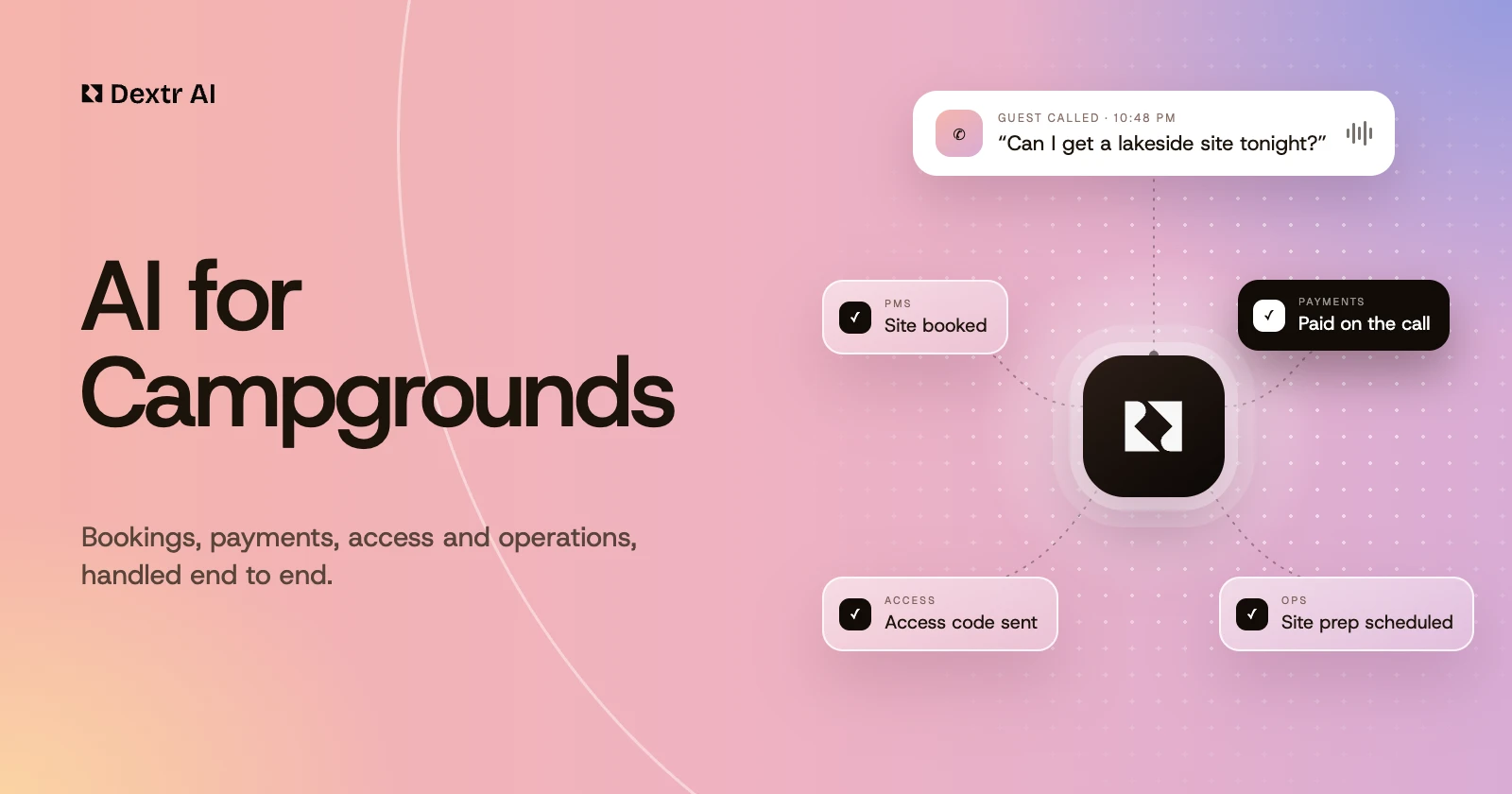
AI for Campgrounds: Book More Sites, Even After Hours
Campers call and text at all hours, and most campgrounds run on a lean front desk. Here is what AI agents can take on, from booking a site and taking payment to sending access codes, routing site prep and keeping every guest informed when the weather turns, and what your team should keep.
AI for campgrounds means AI agents that do the work a campground front desk does all day: answer every call, text and web chat, check site availability, book the site into the reservation system, take payment, send arrival details and access codes, route site prep and maintenance to staff, and reach every guest at once when the weather turns. Done well, it is not a chatbot that answers questions and stops. It finishes the job and hands the exceptions to a person.
That matters because campers do not wait. In a September 2026 survey of 968 U.S. campers by Storable Newbook, 57% said they had given up on a booking in the past year because they could not reach anyone or finish online, and a third said they usually book outside business hours. This guide covers what AI agents can take on at a campground, what to keep with your team, how to roll it out in 30 days and what to measure.
Key takeaways
Campers book around the clock and leave quickly: 57% gave up on a booking last year because they couldn’t reach anyone or finish online, and 47% go to another park after one unanswered call when they can’t book online.
The useful kind of campground AI finishes the work: it books the site in the reservation system, takes payment and sends arrival details, not just an answer.
Answers must come from your park’s own details: site types, hookups, pet rules, quiet hours, river or lake conditions, check-in times.
Access codes should come from a connected lock or access platform, activate for the stay and expire with it.
Emergencies are a communication problem. At Las Pinos Campground, Dextr’s agents reached 50–100 guests at once during a flood, and stopped giving routine river answers while it lasted.
Start with after-hours calls and texts, keep pricing exceptions and refunds with staff, and measure answered calls, bookings captured and requests resolved without staff.
Why Campgrounds Need AI More Than Most Properties
A campground has the guest volume of a small hotel and the staffing of a small business. Many are run by one or two people at the desk, or by the owners themselves, and the same people also check guests in, sell firewood, fix a water line and walk the loops. Three things make the phone harder to keep up with than in a hotel:
Demand arrives in bursts. Holiday weekends and peak season compress months of calls into a few days. At Las Pinos Campground, a river-front property in Texas, guest conversations reached 1,582 in July 2026 alone, with the same lean team.
Questions are specific. Campers ask which sites take a 40-foot trailer, whether a site has shade, whether dogs are allowed in the cabins and how high the river is. A generic answer is a wrong answer.
Booking happens after hours. In the Storable Newbook survey, a third of campers usually book outside business hours, rising to 38% of campers under 45 (RV PRO). At Eli’s Retreat, an RV park and cabin property using Dextr AI, 16.3% of calls came outside 8 a.m. to 8 p.m.
What Campers Ask, and What an AI Agent Can Do With It
Most of the work arrives as the same few requests, by phone, text or web chat. The table shows where an AI agent can finish the job and where it should hand off.
What the camper asks
What an AI agent can do
What staff keep
“Do you have a lakeside tent site this weekend?”
Check live availability by site type, quote the total, book it and take payment
Group blocks and rate exceptions
“Will my 35-foot trailer fit, and do you have 50-amp?”
Answer from the park’s site details and offer only sites that fit
Unusual rigs and site swaps
“We’re arriving at 11 p.m. How do we get in?”
Confirm the booking, send late-arrival directions and the access code for the stay
A lock or gate that has failed
“Can we bring two dogs?”
Apply the pet policy for that site type and add any pet fee
Exceptions to the policy
“The water at site 14 isn’t working.”
Log a maintenance request with the site, time and urgency, and tell the guest what happens next
The repair itself
“Is the campground flooding?”
During an active event, hand off to staff and send the park’s official updates
Every safety decision
8 Jobs an AI Agent Can Take On at a Campground
These jobs follow a camper from the first call to the next booking. Several of them work much as they do with AI in a hotel; the difference is the detail a campground has to get right.
1. Answer and Book Every Call, Text and Chat, Day or Night
The first job is the one that loses the most money when it fails: answering. An AI agent connected to the reservation system can pick up every call on the first ring, reply to texts and web chats, check live availability, quote the total including fees and taxes, and book the site, at 9 p.m. on a Friday as easily as at noon on a Tuesday. It turns the camper’s question into a confirmed reservation in one conversation instead of a voicemail and a callback.
At Las Pinos Campground, Dextr’s voice and text agents handled 5,110 guest conversations between February 27 and August 12, 2026: 462 phone calls and 4,648 text conversations, reaching more than 1,037 guests. Early in the rollout, calls were nearly half of all contact; by July, nearly all of it was by text. Most campgrounds need both channels.
2. Answer From Your Park’s Own Details, Not a Script
A campground’s value is in its specifics, and so are its questions: site lengths and pull-throughs, hookups and amperage, shade, distance to the bathhouse, pet rules by site type, quiet hours, firewood rules, check-in and check-out times. An AI agent should answer from a knowledge base built from your park, and offer only the sites that actually fit the camper’s rig and party. If most of your sites hold RVs, our guide to AI for RV parks goes deeper on rig fit, amperage and monthly stays.
Las Pinos shows what that looks like. Its agents know the river’s depth along the family-friendly low bank and near the swimming hole, that guests may use the river from noon while formal check-in is at 4 p.m., that river access is reserved for overnight guests on major holiday weekends, and that a neighboring business on the same river frontage is a separate operation. Those are the answers that stop a second call.
Keeping that knowledge current matters as much as building it. At Eli’s Retreat, the owners update rates, the pet policy, discounts and road closures by telling DOSS, Dextr’s plain-English configuration assistant, what has changed. “Dogs over 50 lbs are ok now” is enough to change the policy on the next call.
3. Take Payment Without Sending the Camper Away
A booking that ends with “someone will call you back for the deposit” is a booking at risk. The AI agent should take the deposit or full payment during the call, or send a secure payment link by text in the same thread, and write the payment against the reservation. At Eli’s Retreat, Dextr’s voice agent captured more than $9,474 live by phone across 39 bookings and was credited with 60% of the property’s collected revenue, as year-over-year revenue grew 34% from March to August. For card handling, ask any vendor how card details are kept out of call recordings and transcripts.
4. Send Access Codes Through a Connected Lock or Gate System
If your park uses keypad gates, cabin locks or bathhouse doors, access is where late arrivals get stuck. With a connected access platform such as RemoteLock, each guest gets a unique code that activates and expires with the authorized stay, and the AI agent delivers it with the arrival instructions. When a guest cannot find the code or it does not work, the agent can resend the information by voice or text and walk the guest through routine fixes; anything unusual or security-sensitive goes to the on-call person with the details already gathered.
Two rules keep this safe: codes go only to a verified guest on a confirmed booking, and the agent never invents or reads out a code it did not get from the access system.
5. Run Check-In and Late Arrivals When the Office Is Closed
“Can I still arrive tonight?” is the kind of question Las Pinos hears at the busiest moments. Before arrival, the agent can send directions, the site number and map, the access code, parking and quiet-hours rules, and what to do if the office is closed. On the day, it answers the late caller, confirms the site and sends the details again. Staff come in the next morning to a list of who arrived, not a voicemail box.
6. Route Site Prep, Housekeeping and Maintenance to the Right Person
Front-desk work does not stop at the booking. A cabin needs turning, a site needs raking, a sewer connection is leaking, a guest wants extra firewood. An AI agent can turn each request into a task with the site, time and urgency attached, send it to the person on duty and tell the guest what happens next. It can also add the prep for every new arrival to the day’s board, so a late booking doesn’t surprise the grounds crew. The campground no longer runs on sticky notes and radio calls.
7. Reach Every Guest at Once When the Weather Turns
Weather is a safety issue at campgrounds in a way it rarely is in a hotel. The National Weather Service warns campers never to camp on low ground next to streams, “since a flash flood can catch you while you’re asleep,” and notes that “most flash flood warnings will not trigger Wireless Emergency Alerts on your phone” (National Weather Service). Guests cannot count on a phone alert; they need to hear from the park.
When the Brazos River rose in July 2026, Las Pinos Campground was evacuated and roads were closed from July 14 to 16. Its agents reached 50–100 guests at once with alternate routes, hold-in-place guidance and law-enforcement updates, then told guests when access safely reopened on July 20. Just as important, the agents changed behavior: during the active flood they stopped giving routine river answers and sent every river question to the front desk for a real-time update. Write that rule before you need it.
8. Bring Past Campers Back Direct
A camper who stayed once is the cheapest booking you will ever get. The AI agent can segment past guests by season, site type and party, and send approved campaigns for the dates you need to fill: shoulder-season weekends, midweek stays, next year’s holiday weekends before they sell out. At Las Pinos, discount follow-up messages were tuned to the park’s own booking patterns. Keep a named person’s approval on every campaign before it goes out.
Where Staff Still Matter
AI agents handle the routine, and they should hand off the rest with the guest’s name, dates and request already collected, so staff never start from zero. At Eli’s Retreat, the voice agent resolved 71% of conversations start to finish and escalated 415 of 1,419. The top reasons were custom and extended-stay pricing, check-in and check-out exceptions, negotiated rates, cancellations and refunds, and weather and road conditions. That is a useful default list of what to keep with people:
Money exceptions. Custom pricing, monthly and seasonal rates, refunds and disputes.
Safety. Every decision during a flood, fire, storm or medical event. The agent sends the park’s official messages; staff and emergency services decide.
Judgment calls. Guest conflicts, noise complaints that need someone on site, rule breaks.
Live conversations staff want. At Las Pinos, every conversation streams to a private team channel, a manager can step in with one reply, which pauses the AI with full context, and the AI resumes when staff step back.
Tell guests they are talking to an AI and give them a route to a person. Some states set rules here; Utah, for example, requires a business to disclose generative AI when a consumer clearly asks (Davis Polk).
As a member of the Las Pinos front office put it: “We will have time to be present when engaging with guests instead of having to run in another direction to answer the phone.”
The Systems an AI Agent Needs to Reach
An AI agent is only as useful as what it can read and write. Before you choose a vendor, check each of these:
System
What the agent needs from it
Reservation system or PMS
Live availability by site type, rates and fees, and the ability to write bookings and changes
Payments
Deposits and payment links recorded against the reservation
Locks and access
Codes issued for the stay, resent on request, expired at check-out
Phone and SMS
The park’s own number, so campers reach the agent where they already call
Staff channel
Live conversations, handoffs and task alerts where the team already works
If the agent can’t write to the reservation system, staff rekey every booking it takes; if it can’t read rates, it can’t quote. Dextr AI’s guide to connecting AI to your PMS covers what to read, what to write and what to never touch.
A 30-Day Rollout Plan
Week 1: write down your park.
Site types, lengths and hookups, rates and fees, pet and quiet-hours rules, check-in and access steps, who is on call at each hour, and what the agent must hand off. Write the emergency rule now: what the agent says, and stops saying, during a weather event.
Week 2: connect and test.
Connect the reservation system, payments and access platform. Test a lakeside booking, a rig that won’t fit, a late arrival, a failed access code, a maintenance request, a refund request and a flood question.
Week 3: go live after hours.
Put the agent on calls and texts outside office hours first, with every conversation visible to staff.
Week 4: go live all day.
Let the agent answer first during the day, with staff stepping in when they choose, and review the first month’s numbers.
Shows what to teach the agent next and what to keep with people
Access and late-arrival calls per 100 arrivals
Overnight workload and guest frustration
Repeat and direct bookings from past campers
Revenue without a booking-site commission
Where Dextr AI Fits
Dextr AI builds AI agents for hospitality, including campgrounds, RV parks and glamping. Its agents work as a team, inside the systems a park already uses:
Daisy, the voice reservations agent, answers calls 24/7, checks availability, books and changes reservations and captures deposits.
Alfred, the guest messaging agent, handles SMS, chat and digital touchpoints, shares pre-arrival information and answers park-specific questions.
Manny, the operations agent, routes housekeeping, maintenance, turnover and staff follow-ups.
Cosmo, the marketing agent, runs guest re-engagement and direct-booking campaigns.
DOSS lets owners and managers change rules, rates and escalations in plain English.
Dextr AI connects with campground reservation systems such as ResNexus and access platforms such as RemoteLock, and typically goes live in about seven days. See the Las Pinos Campground case study for the full flood timeline and results.
The Bottom Line
Campers book at night, ask specific questions and move on fast when no one answers. AI agents help a campground when they answer every call and text, answer from the park’s own details, book and take payment in the same conversation, send access codes from a connected system, route the work to staff and reach every guest when the weather turns. Start with after-hours calls and texts, keep pricing exceptions, refunds and safety decisions with people, and measure what the agent books and resolves.
Frequently Asked Questions
What is AI for campgrounds?
AI for campgrounds means AI agents that answer a campground’s calls, texts and web chats 24/7 and finish the work: they book sites in the reservation system, take payment, send arrival details and access codes, route maintenance and site prep to staff, and send guest updates in an emergency.
Is a campground AI just a chatbot?
It shouldn’t be. A chatbot answers questions; an AI agent connected to the reservation system, payments and access platform completes the booking, collects the deposit and sends the code, then hands exceptions to staff with the details already collected.
Can AI answer the phone at a campground?
Yes. A voice AI agent can answer every call on the campground’s own number, day or night, check availability, quote and book a site and take payment. At Las Pinos Campground, Dextr’s voice and text agents handled 5,110 guest conversations in five and a half months, 94% without staff involvement.
How does an AI agent know my campground’s details?
It is set up with your park’s own information: site types and lengths, hookups, rates, pet and quiet-hours rules, check-in steps and local conditions. With Dextr AI, owners update that information in plain English through DOSS.
Can an AI agent send gate or door codes?
Yes, when the park uses a connected access platform such as RemoteLock. The access system creates a unique code that activates and expires with the stay, and the AI agent sends it to the verified guest and can resend it if the guest can’t find it.
What should staff still handle?
Custom and extended-stay pricing, refunds and disputes, check-in exceptions, guest conflicts and every safety decision. The AI agent should hand these off with the guest’s details already gathered.
How long does it take to set up AI at a campground?
Dextr AI typically goes live in about seven days. A 30-day plan, going live after hours first and then all day, gives the team time to test bookings, access codes, maintenance requests and emergency rules.
Growth and search specialist with hands-on experience in the AI sector. Covers AI agents, voice AI and automation, and how businesses evaluate and adopt them.
RV parks get questions hotels never do: rig length, amperage, pull-throughs, monthly rates. How AI agents can answer them, book and take payment on the call, and leave the exceptions to your team.
Beyond the headlines about queues and dynamic pricing: how AI agents can sell tickets, handle season passes and group bookings, and answer guests at any hour, and what staff should keep.
A condo hotel answers to guests and to the owners of every unit. How AI agents can book guests, answer owners, follow rental-program rules and keep a lean team in control.
Deepak Sharma · Read article
Ready to grow your business?
×
The demo scheduler is provided by HubSpot and uses functional cookies. Allow functional cookies to book a time here, open the scheduler on HubSpot's site, or use the Inquiry tab.