We use cookies to run this site. With your consent, we also use them for our demo scheduler, analytics and marketing, including identifying the companies and people who visit us. Change your choice anytime under "Cookie Preferences".Privacy Policy
🚀 Dextr AI raised $6.7M to bring an AI workforce to hospitality. Learn more 🚀 Dextr AI raised $6.7M to bring an AI workforce to hospitality. Learn more
GuideRV Park OwnersPark ManagersOutdoor Hospitality Operators
How RV Parks Use AI to Answer Calls and Book the Right Site
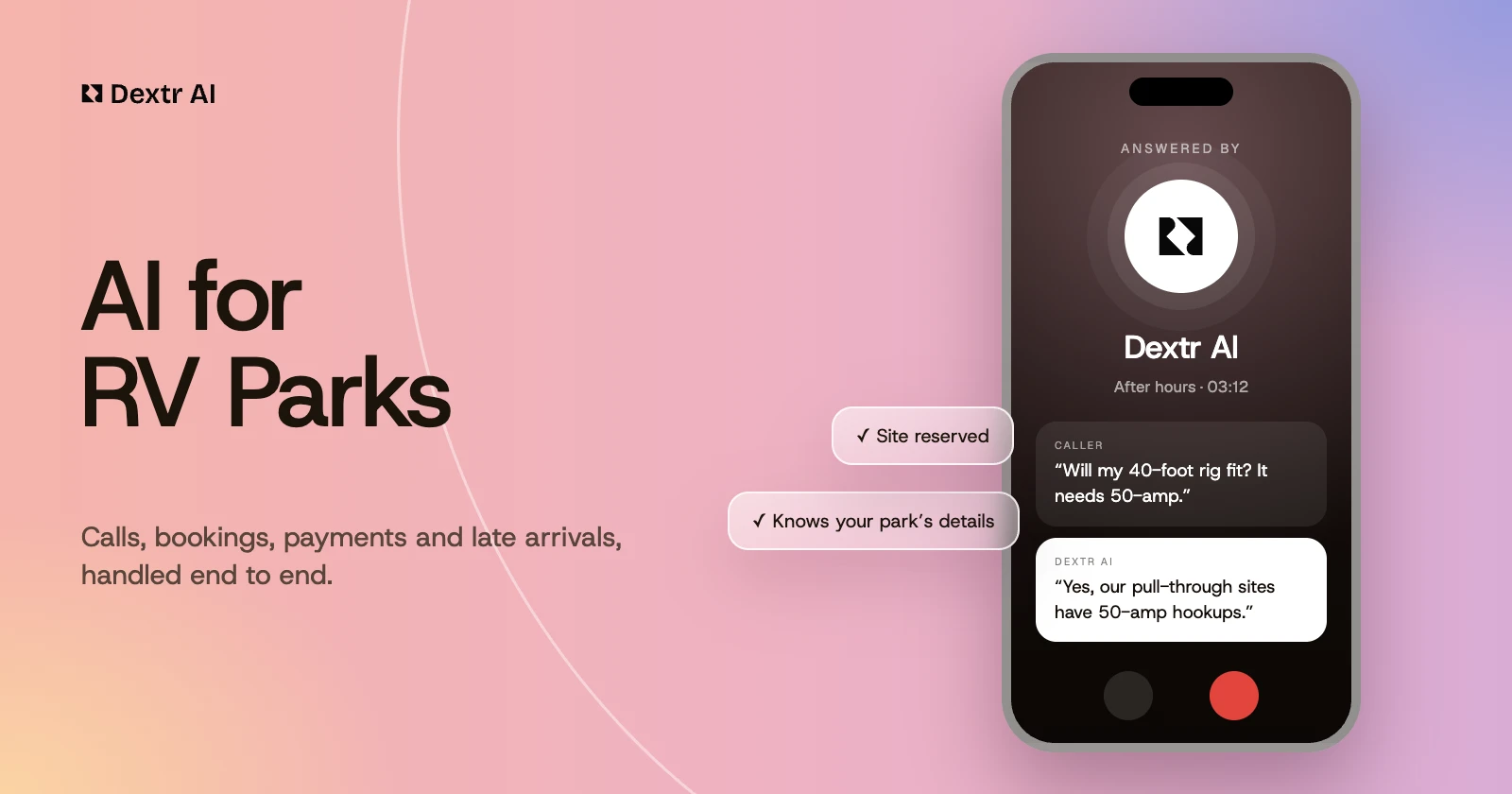
RV parks get questions a hotel never hears: how long is your rig, does it need 50 amps, can you back in? Here is how AI agents can answer them from your park's own details, book and take payment on the call, run monthly stays and late arrivals, and leave the exceptions to your team.
AI for RV parks means AI agents that answer an RV park’s calls and messages 24/7, match each caller’s rig to a site that fits, book the stay into the park’s reservation system, take payment on the call and send arrival details and access codes. Behind the scenes, they route maintenance requests, keep long-term guests informed and pass exceptions to staff with the details already collected.
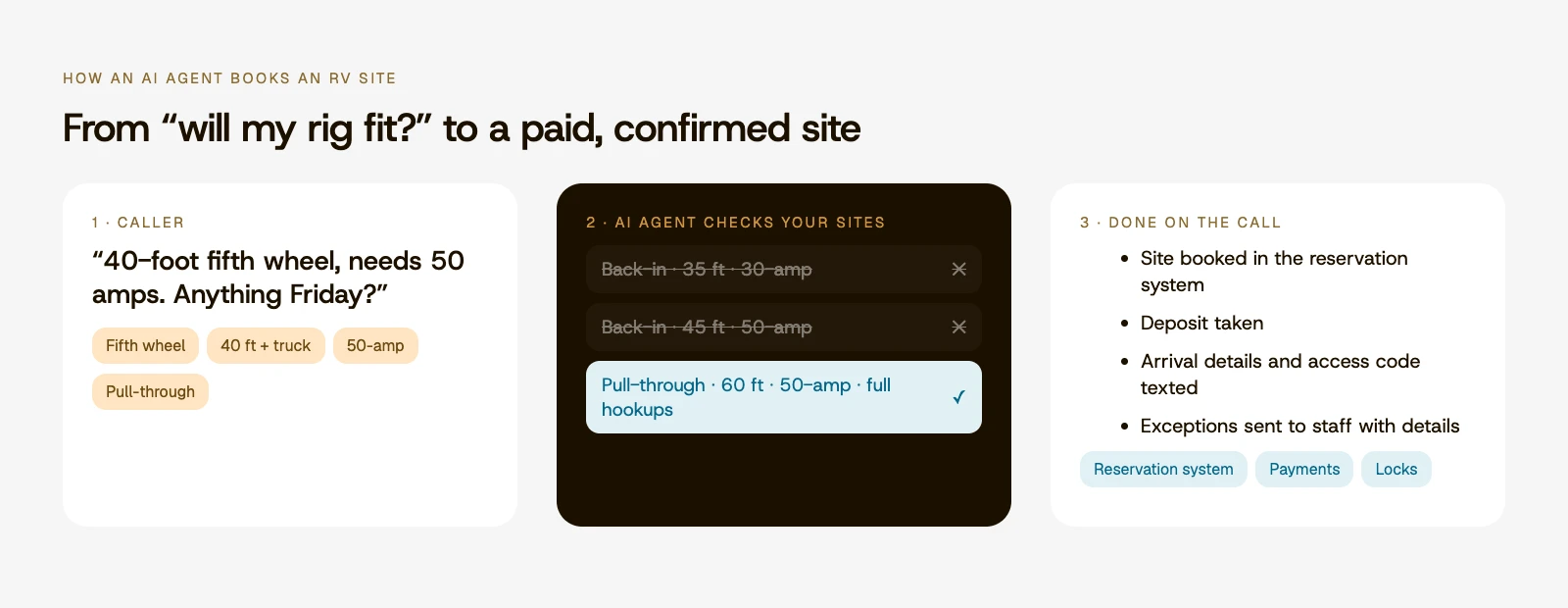
That is different from a chatbot that recites the FAQ page. An RV park booking is a fit problem: a 40-foot fifth wheel that needs 50 amps cannot go on a 30-foot back-in site with 30-amp power, and a guest staying three months is billed and treated differently from one staying three nights. The AI has to know your sites as well as your best front-desk person does, and it has to act in your systems, not just talk.
Key takeaways
Most RV park questions are about fit: rig length and type, amperage, pull-through or back-in, full or partial hookups. An AI agent needs that data per site, not a general description of the park.
An answered call is only useful if it ends in a booking. Connect the agent to the reservation system and payment processor so it can quote, book and take the deposit on the call.
After-hours calls are a real share of demand. At one owner-run RV park, 16.3% of calls came in outside 8 a.m. to 8 p.m.
Long stays need their own rules. Monthly and seasonal rates, metered electric and the legal line between a guest and a tenant should be written down before an AI quotes them.
Keep custom pricing, refunds, evictions and anything about safety with people. At the same park, custom and extended-stay pricing was the top reason calls went to the owners.
Start with after-hours calls and rig-fit questions, then add payments, access codes, maintenance and long-stay messaging.
Why RV Parks Are Different From Hotels and Campgrounds
Demand is steady and the guests are serious about their rigs. In 2025, 8.1 million American households owned an RV, and the median owner used it 30 days a year, up from 20 in 2021, according to the 2025 Go RVing RV Owner Demographic Profile, conducted by Ipsos for the RV Industry Association. KOA’s camping report counted more than 52 million North American households camping in 2025, and 47% of campers said they prefer camping in an RV (RV PRO).
What makes an RV park harder to run than a hotel is that every site is different and every guest arrives with equipment that has to fit it.
Rig fit. Callers describe a class A motorhome, a fifth wheel or a travel trailer plus a tow vehicle, and a length. Sites have a maximum length, a slope, a turning radius and an approach that may or may not suit a big rig.
Power. A 30-amp connection supplies up to 3,600 watts and a 50-amp connection up to 12,000 watts. A 50-amp RV plugged into 30-amp service through an adapter is limited to 3,600 watts (Camping World), which can mean only one air conditioner on a hot night. Guests ask about amperage before they ask about price.
Site type and hookups. Pull-through or back-in, full hookups (water, electric and sewer) or partial, and which sites have a dump station nearby.
Length of stay. One park can mix overnight travelers, weekend families, monthly guests and seasonal residents, each with different rates, deposits, billing and rules.
Late arrivals. RVers drive long days, and many reach the park after the office closes. They need a site number, directions, a gate or door access code and the rules before they pull in.
Each of these jobs ends with something done in your systems, a reservation, a payment, a code, a work order, not just an answer.
1. Answer Every Call and Book the Site on the Call
Most small RV parks have no reservations team. Calls go to the office line, then to the owner’s cell phone, then to voicemail. An AI voice agent connected to the reservation system can answer every call on the first ring, check live availability for the caller’s dates, quote the total with taxes and fees, book the site and take the deposit before the caller hangs up. The same agent can answer texts, so a guest who prefers to message gets a payment link in the same thread.
At Eli’s Retreat, a family-run RV park and cabin retreat in the Texas Hill Country with no front-desk staff, Dextr’s voice agent answered 1,199 calls and 220 text conversations between January 28 and August 8, 2026, captured more than $9,474 live by phone across 39 bookings, and revenue grew 34% year over year from March to August even as overall traffic slowed (case study). As co-owner Sarah put it: “We needed someone who could answer the phone at 11 p.m. on a Friday, quote a cabin, and take the deposit, without either of us picking up.”
2. Match the Rig to a Site That Actually Fits
“Will my rig fit?” is the question RV park staff answer most, and a wrong answer means a guest who cannot get into their site at 10 p.m. The AI agent should ask what a good host would ask: rig type, total length including any tow vehicle, amperage, slide-outs and whether the guest needs a pull-through. It then checks those answers against each site’s maximum length, power, hookups and type, and offers only sites that fit.
This only works if the site data exists. Many parks keep it in a manager’s head or on a paper map. Writing down length, power, hookups, type and any quirks for every site is the most useful hour of setup, and it improves your online booking too. If a site is borderline, the agent should say so and offer a safer site or a call back from staff, not guess.
3. Answer From Your Park’s Own Details, Not a Script
Beyond fit, callers ask about pet limits and breed rules, rig age policies, Wi-Fi, laundry, propane, the dump station, quiet hours, check-in and checkout times, and which road to avoid with a big rig. An AI agent loaded with your park’s rules, site map and amenity guide answers them the same way every time, in your words. At Eli’s Retreat, the agent knows “which back road not to use, which cabins allow big dogs,” the way a longtime employee would.
Rules should come from your written park rules and reservation policies, not the AI’s general knowledge of RV parks. When a question is not covered, the agent should say it will check and pass it on, not invent a policy.
4. Handle Monthly and Seasonal Stays Without Quoting the Wrong Rate
Long-term guests are often an RV park’s most reliable revenue, and their questions are different: monthly or seasonal rates, deposits, whether electric is included or metered, mail, propane delivery, and what happens if they want to extend. An AI agent can quote your published monthly and seasonal rates, explain how metered electric is billed under your policy, check availability for the full length of the stay, send payment links and reminders for recurring charges, and tell a guest when their stay is coming up for renewal.
Two cautions. First, custom pricing should stay with people: at Eli’s Retreat, “custom and extended-stay pricing” was the most common reason the AI handed a call to the owners, 192 times in about six months, with the guest’s name, dates and request already collected. Second, very long stays can change the legal relationship. In Florida, for example, when a park knowingly lets a guest occupy an RV continuously for more than six months, the law presumes the occupancy is nontransient and landlord-tenant eviction procedures apply (Florida Statutes, chapter 513). Rules differ by state, so set the AI’s maximum bookable length and its long-stay wording with your attorney, and route anything near that line to a manager.
5. Run Late Arrivals and Access Codes
A guest arriving at 11 p.m. needs the site number, directions inside the park, the gate or door access code and the rules that matter tonight, quiet hours, where to dump, where not to park the tow vehicle. An AI agent can send all of it by text before arrival and answer follow-up questions when the guest pulls up.
If the park uses a connected lock or access system, Dextr AI can deliver access codes that activate and expire with the stay and resend a new code when a guest is locked out, through its RemoteLock integration. Codes should go out only for paid, confirmed stays, and a gate or lock that has failed should go to the on-call person, not stay with the AI.
6. Turn Guest Problems Into Work Orders
“My pedestal breaker keeps tripping,” “the sewer connection at site 22 is leaking,” “the bathhouse is out of paper.” Today these arrive as calls to the office, notes on the door or texts to the owner. An AI operations agent can take the request by voice or text, ask the questions maintenance will need, log a work order with the site number and urgency, tell the guest when to expect someone and close the loop when the job is done.
Electrical and safety issues need clear rules: the agent should give the guest your standard safety instruction, such as switching off the pedestal breaker, and page the on-call person immediately, never troubleshoot wiring. Long-term guests in particular notice whether problems get fixed, so the time from request to close is worth tracking.
7. Reach Every Occupied Site, Then Bring Guests Back
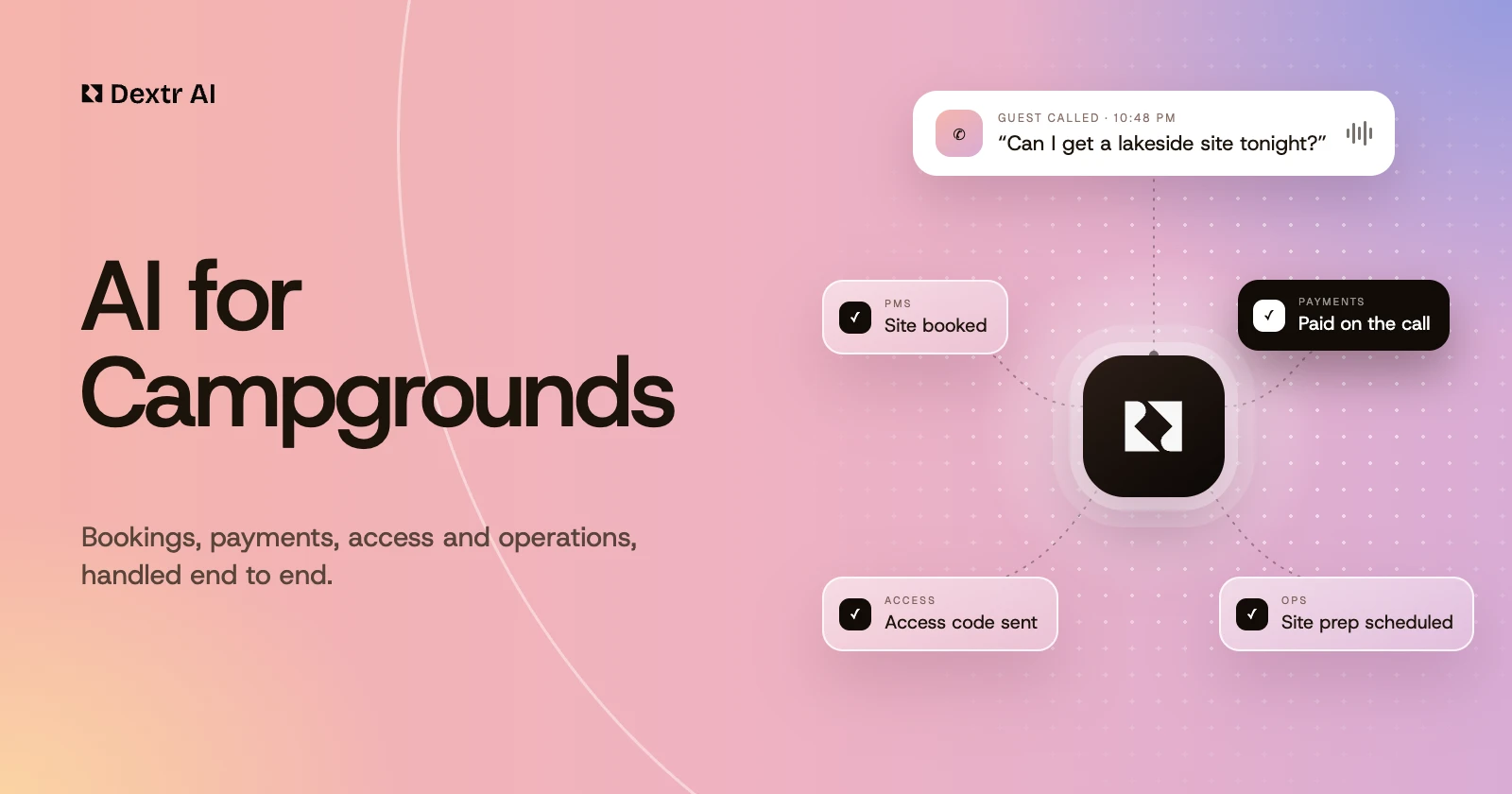
When a storm, flood warning, water shutoff or road closure hits, staff can spend an hour walking the loops. An AI agent can send one message to every occupied site in seconds and answer the replies. For a real example from outdoor hospitality, see how a river-front campground used Dextr’s agents during a flood in the Las Pinos Campground case study. For tent sites, cabins and mixed parks, see our guide to AI for campgrounds.
After checkout, the same system can follow up: a thank-you, a review request, and an offer for next season to guests who stayed before, timed around your own calendar. Dextr’s marketing agent drafts these campaigns, and a person approves them before they are sent.
What to Automate First
Not every job is worth automating on day one. Order them by how much revenue or time they recover and how easy they are to get right.
Job
Why start here
What you need first
After-hours calls and texts
Calls that reach voicemail are bookings you lose
Reservation system connection, call forwarding
Rig-fit questions
The most common question, and the one that causes bad arrivals
Length, power, hookups and type for every site
Payment on the call
Turns a reservation into a paid one
Payment processor connection, deposit and cancellation rules
Late arrivals and access codes
Removes the 10 p.m. phone call to the owner
Arrival instructions, connected lock or gate system
Maintenance requests
Fewer calls to staff, faster fixes
Who handles what, on-call rota, safety rules
Monthly and seasonal stays
High value, but needs clear written rules
Long-stay rates, electric policy, maximum stay, legal review
Alerts and win-back messages
Safety and repeat business
Occupied-site contact list, approval step
A 14-Day Rollout Plan
Dextr AI can typically take an RV park live in as little as seven days from kickoff. The plan below adds a second week to watch real calls before handing over long stays and maintenance.
Days 1–3: write down the park.
Build the site sheet: length, power, hookups, pull-through or back-in, and quirks for every site. Gather park rules, pet and rig policies, rates including monthly and seasonal, deposit and cancellation terms, arrival instructions and the escalation list for each hour of the day.
Days 4–7: connect and test.
Connect the reservation system, payment processor and any lock or gate system. Test a big-rig booking, a 30-amp RV asking for 50 amps, a monthly inquiry, a late arrival, a lockout and a tripped breaker. Go live on after-hours calls.
Days 8–14: listen, then widen.
Review transcripts daily and fix any answer that was wrong or vague. Then switch on daytime overflow, maintenance requests and long-stay messaging, with custom pricing still routed to a manager.
What Stays With Your Team
An AI agent should handle the routine and hand over the rest with the details already collected. At Eli’s Retreat, the agent resolved 71% of guest conversations start to finish and escalated 415 of 1,419, mostly custom and extended-stay pricing, check-in and checkout exceptions, rate exceptions and cancellations. Keep these with people:
Custom and negotiated pricing, including long-stay deals outside your published rates.
Refunds and disputes beyond your written cancellation policy.
Evictions, rule enforcement and anything legal about long-term occupancy.
Safety: electrical faults, gas, medical issues, flooding and fire. The AI gives your standard safety instruction and pages a person.
Borderline rig fit: if a site is marginal for the rig, a person who knows the turn should decide.
What to Measure
Metric
What it tells you
Calls answered, and share after hours
How much demand was going to voicemail
Bookings and revenue taken on the call
Whether answered calls turn into paid stays
Conversations resolved without staff
How much time the team gets back
Arrivals moved because a rig did not fit
Whether the site data and fit questions are right
Lockout calls per 100 arrivals
Whether arrival instructions and codes work
Time from maintenance request to close
What long-term guests experience
Escalations by reason
Which rules to write down next
Where Dextr AI Fits
Dextr AI builds AI agents for hospitality that work inside the systems a property already uses. For RV parks, that is a small team of agents:
Daisy, the AI voice reservations agent, answers calls 24/7, checks availability, books and changes reservations and captures deposits.
Alfred, the AI guest messaging agent, answers texts and chat, sends arrival details and access codes and resolves requests during the stay.
Manny, the AI operations agent, routes maintenance, turnover and staff follow-ups.
Cosmo, the AI marketing agent, runs re-engagement and direct-booking campaigns, with a person approving what goes out.
Each park can give its voice agent its own name and personality; at Eli’s Retreat it is called Danny. During onboarding, Dextr uploads the park’s own knowledge, hookup types, pet policies, amenity guides and site maps, so the agents answer from your details. Dextr integrates directly with major campground and RV park management systems such as ResNexus and RMS Cloud. Managers change rules and escalations in plain English in DOSS. For how AI connects to a reservation system in general, see our guide to connecting AI to a PMS.
The Bottom Line
An RV park sells sites that have to fit a rig, a power need and a length of stay. AI agents earn their place when they know every site, answer every call, book and take payment on the call, send arrival details and access codes, and pass the exceptions to your team with the details already collected. Start with after-hours calls and rig-fit questions, write down your long-stay rules before the AI quotes them, and measure bookings, not just answered calls.
Frequently Asked Questions
How can AI help an RV park?
AI agents can answer calls and texts 24/7, match each rig to a site that fits, book the stay and take payment on the call, send arrival details and access codes, log maintenance requests, message every occupied site during an emergency and bring past guests back. Exceptions such as custom pricing go to staff.
Can an AI answer the phone for my RV park after hours?
Yes. An AI voice agent can answer on the first ring at any hour, check availability, quote rates and book the site. At one owner-run RV park, 16.3% of calls came in outside 8 a.m. to 8 p.m., and the AI resolved 71% of guest conversations without the owners.
How does an AI know whether a rig fits a site?
It asks the caller for rig type, total length, amperage and whether they need a pull-through, then checks the answers against each site’s maximum length, power, hookups and type. That requires accurate site data, which you provide during setup.
What is the difference between 30-amp and 50-amp RV service?
A 30-amp connection supplies up to 3,600 watts and a 50-amp connection up to 12,000 watts. A 50-amp RV can plug into 30-amp service with an adapter, but it is limited to 3,600 watts, which may not run more than one air conditioner.
Can AI handle monthly and seasonal RV stays?
It can quote published monthly and seasonal rates, explain your metered-electric policy, check availability for the whole stay and send payment links and renewal reminders. Custom long-stay pricing and anything about tenancy law should stay with a manager.
Can the AI take payment and send access codes?
Yes, when it is connected to your payment processor and to a lock or access system. Dextr AI takes payment on the call and, through its RemoteLock integration, delivers access codes that activate and expire with the stay.
Which RV park reservation systems does Dextr AI work with?
Dextr AI integrates directly with major campground and RV park management systems, including ResNexus and RMS Cloud, and with other property management systems used in hospitality.
How long does it take to set up AI for an RV park?
Dextr AI can typically go live in as little as seven days from kickoff, covering the park’s knowledge, the reservation system connection and calibration. Many parks then spend a week reviewing calls before handing over long stays and maintenance.
Growth and search specialist with hands-on experience in the AI sector. Covers AI agents, voice AI and automation, and how businesses evaluate and adopt them.
Campers call and text at all hours, and most campgrounds run on a lean front desk. How AI agents can book sites, take payment, send access codes, route site prep and keep guests informed when the weather turns.
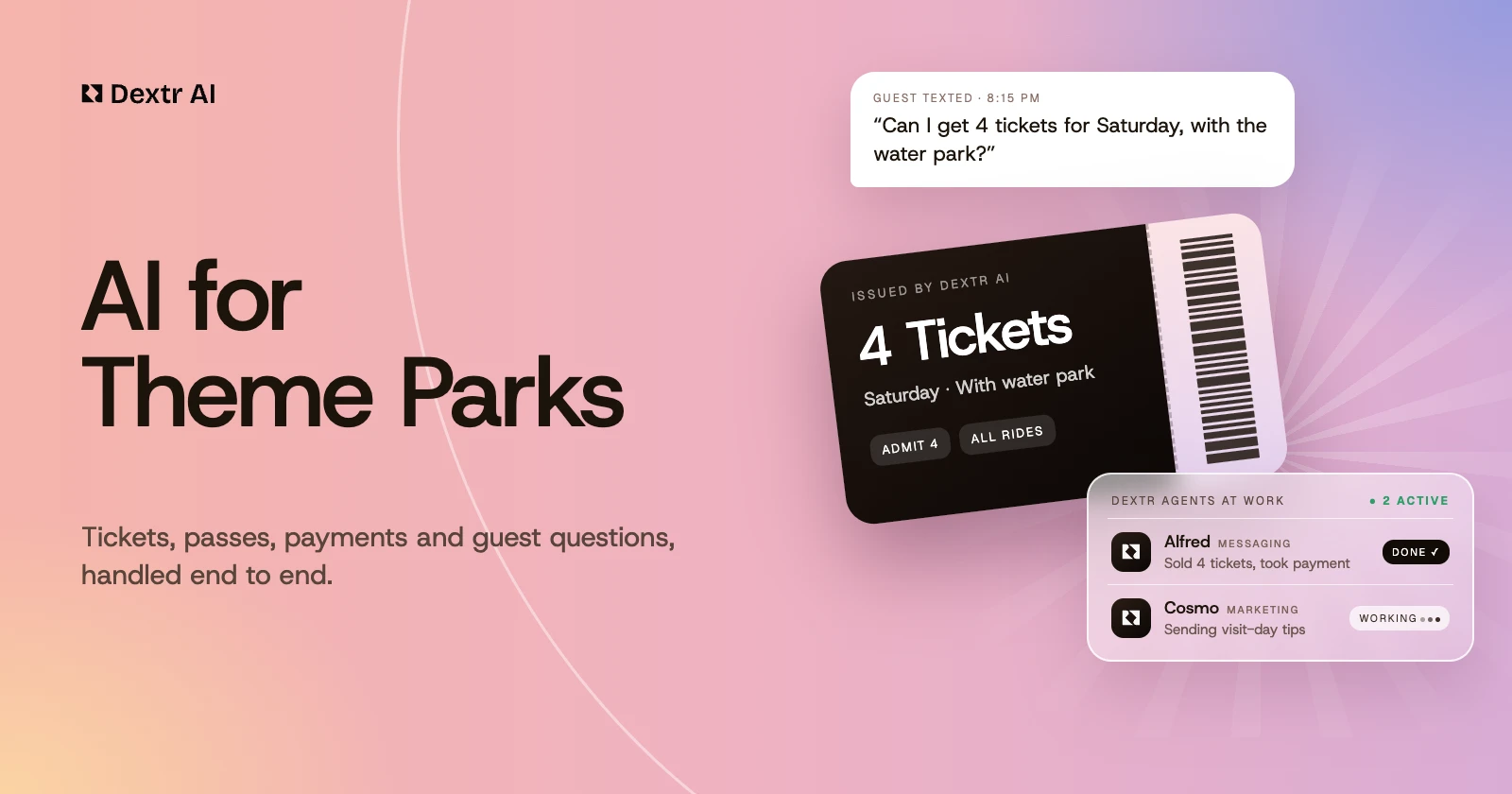
Beyond the headlines about queues and dynamic pricing: how AI agents can sell tickets, handle season passes and group bookings, and answer guests at any hour, and what staff should keep.
A condo hotel answers to guests and to the owners of every unit. How AI agents can book guests, answer owners, follow rental-program rules and keep a lean team in control.
Deepak Sharma · Read article
Ready to grow your business?
×
The demo scheduler is provided by HubSpot and uses functional cookies. Allow functional cookies to book a time here, open the scheduler on HubSpot's site, or use the Inquiry tab.