We use cookies to run this site. With your consent, we also use them for our demo scheduler, analytics and marketing, including identifying the companies and people who visit us. Change your choice anytime under "Cookie Preferences".Privacy Policy
🚀 Dextr AI raised $6.7M to bring an AI workforce to hospitality. Learn more 🚀 Dextr AI raised $6.7M to bring an AI workforce to hospitality. Learn more
How to Automate a Hotel: Keyless Entry, AI Agents and the Order That Works
Automating a hotel is less about robots than about connecting the PMS, payments, door locks and AI agents in the right order. Here is the six-layer stack, the late-arrival test every setup should pass, what breaks, what the law requires, and what to keep human.
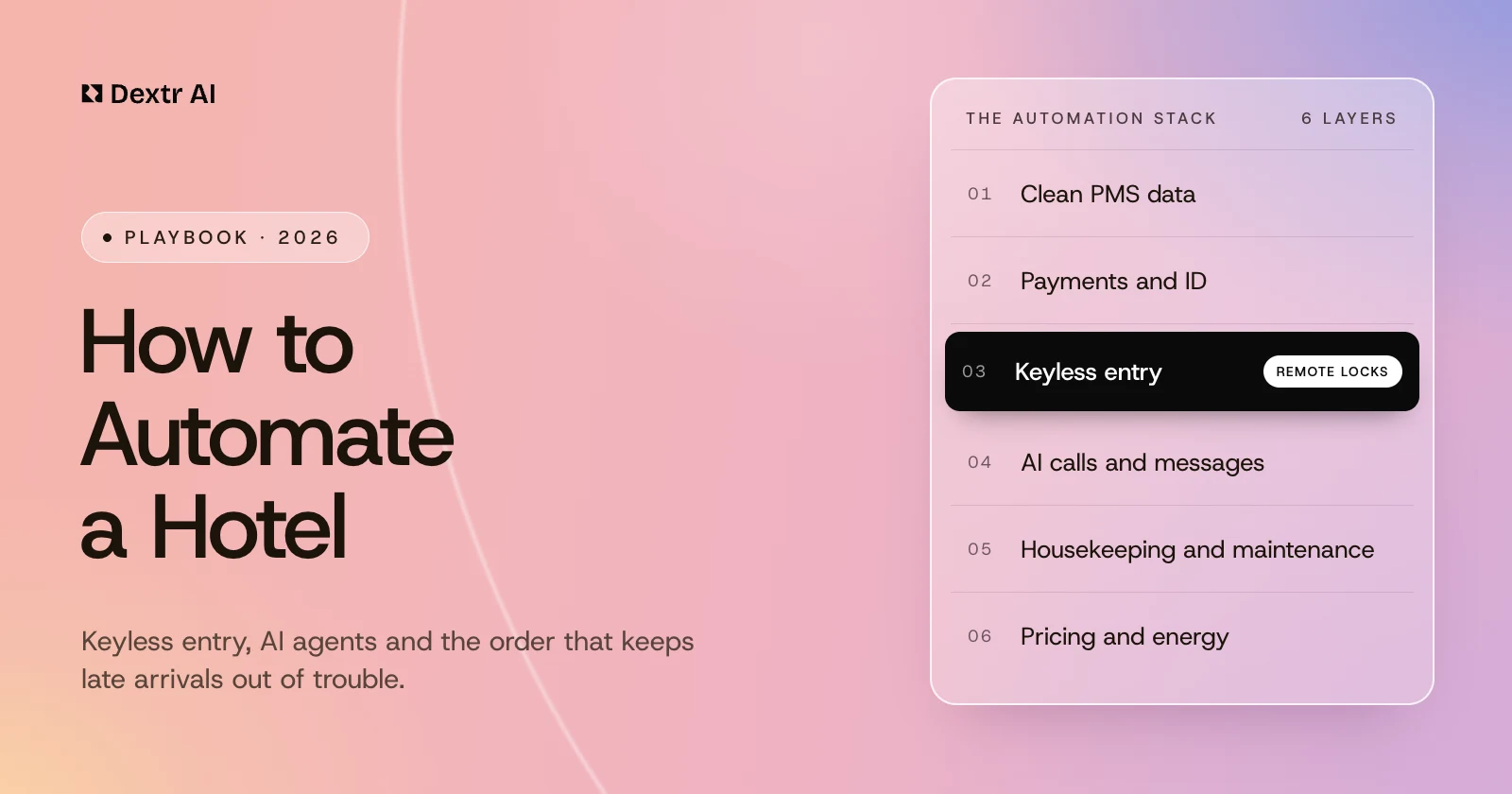
To automate a hotel, connect six layers in this order: PMS data and room status; payment and ID capture before arrival; keyless entry tied to the reservation; AI agents for calls, texts and email; housekeeping and maintenance routing; and finally pricing and energy. Each layer depends on the one before it.
An automated hotel still has people. Routine work runs on its own: the phone answered at midnight, the door code sent when the room is ready, the next room to clean assigned at checkout. Staff handle the moments that need judgment. Out of order, automation backfires: a door code sent before the room is inspected, or an AI that cannot see the reservation, creates more work than it saves.
Key takeaways
Automate in dependency order: PMS data, then payments and ID, then keyless entry, then AI agents, then housekeeping and maintenance, then pricing and energy.
Keyless entry is only as good as the data behind it. Room moves, early checkouts and manual check-ins behave differently in each PMS and lock connection, so test them before you rely on them at night.
AI agents close the gap that locks leave. A guest locked out at night needs an answer in seconds, and a person if the lock itself has failed.
Local law can require staffed hours: New York City now requires continuous front-desk coverage. Check your licensing before planning unstaffed nights.
An AI that books rooms inherits legal duties: quote the total price including mandatory fees, and let guests book accessible rooms as easily as anyone else.
Measure completed arrivals, lockout calls, missed calls and labor hours per occupied room, not the number of messages sent.
What Hotel Automation Means in Practice
Hotel automation covers two kinds of tools. Rules-based workflows run a fixed sequence: when a reservation is confirmed, send the pre-arrival message 48 hours before arrival. AI agents handle the requests that do not follow a script: they understand what a guest is asking, decide the steps and act inside your systems. Most hotels need both: workflows for the predictable sequences, agents for the conversations in between. Our guide to AI for hotels covers the seven main uses.
Area
What can run on its own
What still needs a person
Reservations
Answering calls and messages 24/7, quoting, booking, changing and cancelling within policy
Group contracts, rate disputes, exceptions to policy
Check-in and access
Registration, ID and card authorization before arrival; door codes or mobile keys that start and end with the stay
Failed ID checks, suspected fraud, a lock that will not open
Guest requests
Answering questions, upsells such as late checkout, routing requests to the right team
Complaints that need recovery, compensation and safety issues
Housekeeping
Building the cleaning board from departures and arrivals, prioritizing early arrivals, logging room status
Inspections, lost property, damage
Maintenance
Turning guest reports into work orders, scheduling preventive maintenance
The repair itself, and anything affecting safety
Revenue and energy
Rate recommendations inside set limits; room temperature setbacks when rooms are empty
Pricing strategy, limits and overrides
The pressure to automate comes from labor. The roles that are hardest to fill, housekeeping and the front desk, are also where guests most need a fast answer:
50%+
Hotels understaffed
More than half say somewhat or severely, in an AHLA survey of 246 hoteliers
65%
Owners citing labor costs
One of the most-cited financial pressures in the same survey
~$49K
One overnight desk shift
Yearly wages at the U.S. median, before taxes and benefits
3.5×
Hidden call demand
After-hours and overflow calls ran 3.5–3.9× what staff had been answering
94%
Resolved without staff
Of 5,110 guest calls and texts at one campground
70%
Would check themselves in
U.S. travelers likely to use an app or kiosk instead of the front desk
Each layer reads from the one below it. Skipping a layer moves its problems up the stack, where guests see them.
Layer
What it automates
Skip it and…
1. PMS data and room status
One accurate record of rates, reservations, guests and room status
Every other layer acts on wrong data
2. Payments, ID and registration
Card authorization, ID and the registration card before arrival
Codes go to guests who have not paid or been verified
3. Keyless entry
Door codes or mobile keys issued from the reservation
Someone hands out keys or reads codes aloud all night
4. AI agents
Calls, texts, chat and email answered and acted on 24/7
Guests with a question or a failed code reach voicemail
5. Housekeeping and maintenance
Cleaning boards, room status updates and work orders
Rooms are not ready when codes go live
6. Pricing and energy
Rate recommendations and empty-room setbacks
Revenue and utility savings are left on the table
1. Get the PMS Data and Room Status Right
Your property management system (PMS) is the source every other tool reads. Before automating anything, make sure room status changes the moment housekeeping finishes, ideally from a phone rather than a list handed in at the end of the shift. Clean up rate plans, room names and policies, and capture a mobile number and email on every reservation, because that is where codes and messages will go.
Room names matter more than they seem. Lock platforms map each PMS room to a door, and Cloudbeds warns in its RemoteLock guide that an incorrect or outdated mapping can stop access codes being generated or sent. A useful test: could someone outside the hotel tell, from the PMS alone, which rooms are clean, who arrives tonight and what each guest owes? If not, fix that first. Dextr AI’s guide to connecting AI to your hotel PMS covers the data an AI agent needs.
2. Capture Payment, ID and Registration Before Arrival
Send a pre-arrival link that collects the registration card, a photo ID and a card authorization on the guest’s phone, with no app to download. Release the door code only when all three are complete. That one rule removes most of the risk people worry about with self check-in: the code goes to a verified guest whose stay is guaranteed.
Keep card numbers inside your payment gateway, which returns a token attached to the reservation. Decide what happens when a check fails: the guest gets a payment link, or the request goes to a person. Check what your local registration rules require you to record, covered below.
3. Connect Keyless Entry and Remote Locks to the Reservation
Remote locks let you issue, change and cancel access without touching the door. Connected to the PMS, the lock platform can create a code or mobile key for each reservation that works only for that room and only during the stay. When a guest moves rooms, the old code should stop and a new one start. When they extend or take late checkout, the end time should move with the folio.
The same platform should handle staff and vendor access: recurring codes for housekeeping, one-time codes for a contractor, and a record of who opened which door and when. Platforms such as RemoteLock manage time-bound guest codes and scheduled staff credentials across many lock brands from one place, which matters if your property mixes old and new hardware. Condo hotels add another layer: building entrances and garages need codes too, and units in owner use must be left out (see AI for condo hotels).
4. Put AI Agents on Calls, Texts and Email
Once the data, payments and access layers are solid, AI agents can handle what a night auditor or reservations agent does by phone and message: answer questions, book and change stays, resend a code, explain parking at 1 a.m., and pass anything unusual to a person with the details attached. An agent connected to the PMS and the lock platform can check whether a code is live before it answers.
5. Route Housekeeping and Maintenance Automatically
Checkouts should create cleaning tasks, arrivals should set their priority, and an inspection should be what releases the next guest’s code. Guest messages such as “the shower is cold” should become work orders with the room, time and urgency attached, assigned to whoever on shift can finish soonest.
Asking guests whether they want daily service can cut cleaning hours, where the law allows it. In New York City, the decline has to come from the guest and cannot be rewarded, so an automated message can ask but should never opt guests out. Los Angeles is stricter: a hotel can skip a cleaning only when the guest opts out without being asked, so an automated message there should not raise it.
6. Automate Pricing and Energy Last
Revenue management systems recommend rates from booking pace, seasonality and competitor prices; set floors, ceilings and an approval owner before letting them publish. Guest-room energy controls lower heating and cooling when a room is empty and restore it before arrival. Energy codes in California and Washington require these setbacks in hotels built under them (in Washington, hotels with more than 50 guest rooms). Washington also requires a deeper setback for unrented rooms: within 16 hours, or after 20 minutes when a networked system shows the room is unrented and empty. Knowing which rooms are unrented is where the PMS connection pays off.
Choosing Keyless Entry: PIN Codes, Mobile Keys or Cards
PIN code keypad
Mobile key
RFID card
How the guest gets in
Types a code sent by text or email
Taps a phone, through an app or a wallet pass
Taps a card encoded at a desk or kiosk
Needs a smartphone
No: the code can be read out by phone or emailed
Yes
No
Arrival without staff
Yes
Yes
Only with a kiosk or card dispenser
Room move or extension
New code or new end time issued remotely
Key updated remotely
Card re-encoded on site
Good fit
Small hotels, motels, condos, cabins, campgrounds
Brands with an app, business travelers
Larger hotels with a staffed desk
For independents, PIN codes are usually the safest start because every guest can use them. App-based mobile keys depend on guests downloading something, and many guests are not asking for them: in an Ipsos survey of 1,169 German hotel guests for Mews (2025), only 13.1% preferred digital keys over key cards, though 34.8% would like to try them (Mews). Wallet keys skip the app at the door, though guests usually add them from the hotel’s app first: Apple Wallet room keys on supported dormakaba locks use NFC and keep working for up to five hours after the iPhone needs a charge (dormakaba). Keep cards as the fallback.
What Happens When the Internet Drops
Many connected locks keep accepting codes already stored on the lock when Wi-Fi or a hub goes down, but not all do: it depends on the lock and how it is set up. What stops is change: new codes, changed end times and live access logs wait until the connection returns.
RemoteLock says its ReadyPIN option lets a lock validate an encrypted PIN and its schedule with or without a Wi-Fi connection (RemoteLock).
Salto says its battery-powered KS locks are not affected by a building power outage, but the on-site hub needs mains power or a UPS: if the hub loses power, only locks set up for offline access keep opening. If the hub stays powered but loses the internet, doors keep working and new access-rule changes wait until connectivity is restored (Salto).
Battery locks send low-battery alerts. If the batteries die anyway, some keypad locks can be powered for a moment with a 9V battery held to contacts outside the door; others open only with a mechanical override key. Keep a 9V battery and the override keys where the on-call manager can reach them.
Put routers and hubs on a UPS, and issue each code as soon as the room is inspected, not at arrival time, so it reaches the lock before any outage.
Room Moves, Late Checkout and Early Departure
Edge events are where self check-in breaks, and each PMS connection handles them differently. The PMS vendors’ own RemoteLock setup guides show three different behaviors:
A date change updates the existing code automatically. On room changes the guide gives two answers: one says the PIN updates on its own, another says to set up a room-change automation. Revoking access at early checkout needs an automation. An outdated room mapping can stop codes being generated or sent.
After a room move the PIN stays the same and the old room stops accepting it. Checking a guest out does not end their access; it runs to the scheduled end time. A guest checked in by a staff user in the PMS is not emailed the PIN automatically.
PINs follow the stay dates and check-in and checkout times, and paid early check-in or late checkout moves the window. Changing locks on an active reservation can affect access.
Before you depend on keyless entry at night, test a room move, a date change, an early checkout, a late checkout and a manual check-in on your own setup, and write down what the guest experiences in each.
Questions to Ask a Lock Vendor
Does it connect to my PMS, and which reservation changes update the code automatically?
Which codes keep working offline, and how are new ones issued during an outage?
How are low batteries reported, and how much warning do we get?
Can we see and export an access log for every door?
How do staff and vendor codes work, and how fast can we cancel one?
How are security fixes delivered? In 2024, researchers disclosed a flaw in dormakaba Saflok locks used on around three million doors across 13,000 hotels, and each lock had to be updated or replaced (Kaspersky).
The Late-Arrival Test: 11:40 p.m. With No One at the Desk
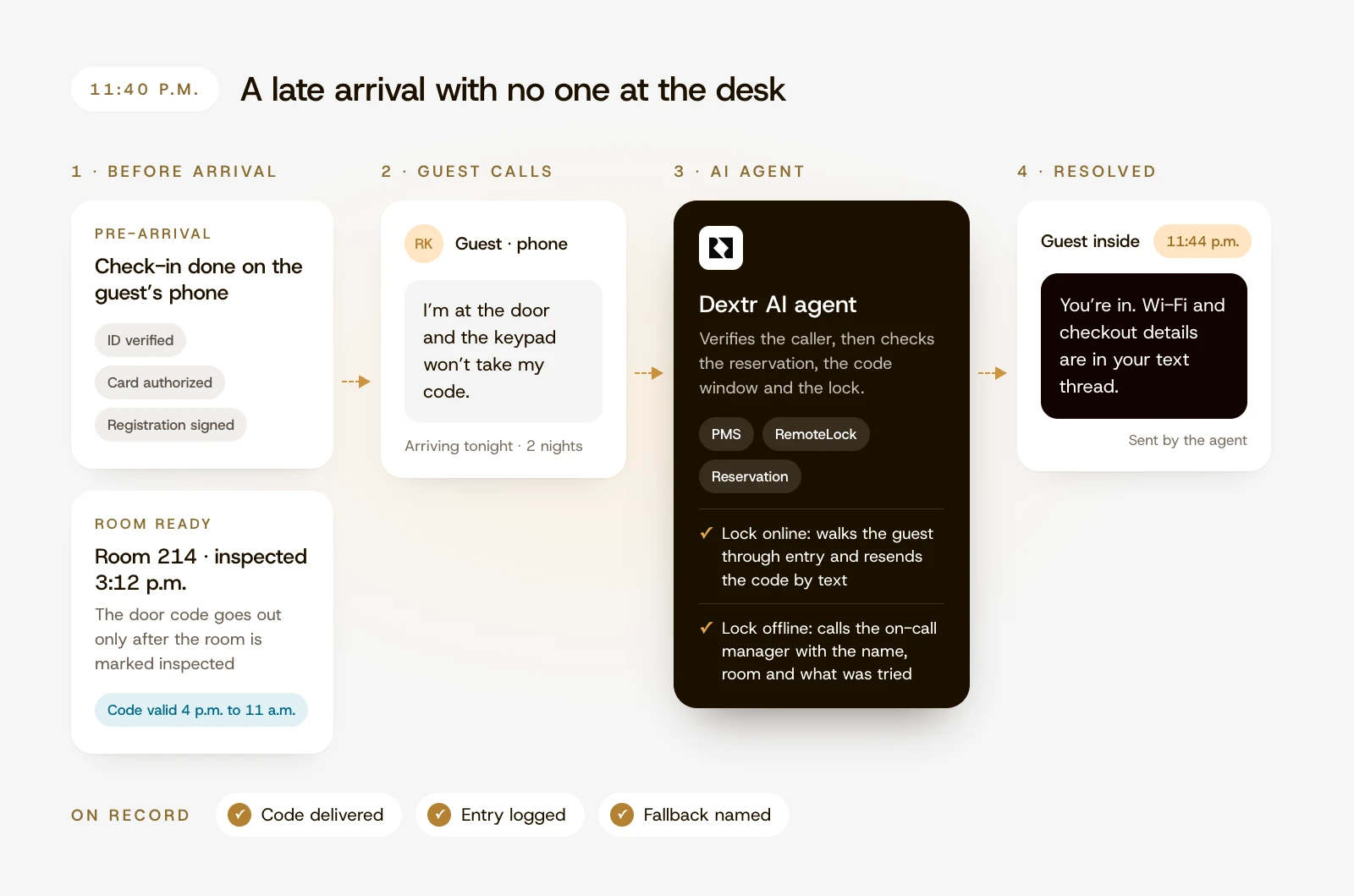
Late arrivals are the hardest test, because they happen when no one is at the desk to fix a code that will not open the door. The best way to judge an automated setup is to walk one late arrival through it. If every step works with no one at the desk, and every failure reaches a person within minutes, the setup is ready.
Two days before arrival, the guest completes the registration card, ID and card authorization on their phone.
Housekeeping marks the room inspected at 3:12 p.m. The lock platform issues a code that works from 4 p.m. on arrival day until 11 a.m. on checkout day, and the guest receives it by text and email.
At 11:40 p.m. the guest calls: the keypad will not take the code. The AI agent verifies the caller, checks the reservation, the code’s time window and the lock’s status.
If the lock is online, it walks the guest through entry and resends the code. If the lock is offline, it calls the on-call manager with the guest’s name, room and what has been tried, and tells the guest who is coming and when.
The record shows the code was delivered, the entry was logged and the fallback had a name. A setup that cannot show those three things is not ready to run unstaffed hours.
What Breaks, and the Fallback for Each
Failure
Prevention
Fallback
Code never arrives
Confirm the mobile number at booking; register your business texting; send by text and email
The AI agent verifies the guest and resends, or reads the code after verification
No code was generated
Re-check room mapping whenever rooms are renamed or added; make sure manual check-ins still send codes
A check before evening arrivals that every arriving guest has a working code
Lock offline or battery dead
Battery and connectivity alerts every morning; hubs on a UPS
On-call manager with an override key or backup credential
Room not ready when the code starts
Issue codes only after inspection
The agent tells the guest the truth and offers a time or another room
Guest moves rooms, extends or leaves early
Test how your PMS and lock connection handles each event
The agent confirms the new code or end time; staff revoke access where it is not automatic
Guest has no smartphone
Offer PIN codes by email or voice
The agent reads the code after verifying the caller
ID or payment check fails
No code until checks pass
Payment link, then a person
Noise, safety or medical incident
Clear house rules sent before arrival
Immediate escalation to the on-call person, and emergency services when needed
Lock security flaw
Apply lock firmware updates when the vendor releases them
Re-key or replace affected locks
Power or internet outage
Backup internet; printed arrivals list; locks that keep issued codes
On-call manager on site
Rules That Limit What You Can Automate
These rules vary by country, state and city, so check the ones that apply to your property before you remove staffed hours or switch a process off.
Area
What it requires, and what to do
Fire exits
Guest-room doors must open from the inside without a key or tool (2021 IBC and NFPA 101; summary). Electronic locks can change how guests get in, never how they get out.
Accessible booking
In the U.S., guests with disabilities must be able to book accessible rooms through any channel, including phone, the same way as other guests (28 CFR 36.302(e)), and keypads must work with one hand (U.S. Access Board). An AI booking agent inherits that duty.
Staffed front desk
New York City has required continuous front-desk coverage since May 2025, with an overnight security-guard alternative (Cole Schotz). Check your local licensing before planning unstaffed nights.
Daily housekeeping
New York City requires daily cleaning unless the guest declines, and both New York City and Los Angeles bar rewards for declining (Cole Schotz; ECJ Law). Los Angeles lets a hotel skip a cleaning only when the guest opts out without being asked (City of Los Angeles). In New York City, an automated message can ask, but never opt guests out by default. In Los Angeles, it should not ask at all.
Guest registration
UK hotels must record the name and nationality of every guest aged 16 or over, and passport details for guests who are not British, Irish or Commonwealth citizens (Hotel Records Order 1972). Spain requires guest and payment data to reach the authorities within 24 hours, with fines of up to €30,000 (Conesa Legal). Self check-in must collect what your country requires.
Business texting
U.S. carriers have blocked texts from unregistered 10-digit business numbers since February 2025 (Telnyx; Twilio). Register your texting before door codes depend on it.
Total prices
The FTC fee rule, in effect since May 12, 2025, requires clear total prices for hotels and rentals, including on the phone (16 CFR 464.1). California’s SB 478 bans prices that leave out mandatory fees (California Attorney General). An AI agent should quote the total.
Energy codes
For new and altered buildings, California’s Title 24 requires guest-room thermostats to set back at least 5°F within 30 minutes of a room being vacated (Energy Code Ace). Washington’s energy code requires new and altered hotels with more than 50 rooms to set an unrented room to at least 80°F for cooling and no more than 60°F for heating within 16 hours, or after 20 minutes when a networked system shows it unrented and empty (WAC 51-11C). Tie thermostats to room status.
AI disclosure
Rules on telling callers they are talking to AI, and on recording calls, vary by state and country. In the EU, AI systems that interact with people have had to make clear they are AI, by the first interaction at the latest, since August 2, 2026 (EU AI Act, Article 50). Have the agent say it is an AI at the start of every call and chat, and check consent before recording.
What Hotel Automation Costs
There is no single price, because the locks and systems you already have decide most of it. These benchmarks help frame a budget:
Cost
Benchmark
Mobile-key software
About $3 to $5 per room per month for Vingcard’s mobile-key software, according to Hotel Tech Report (2026)
Lock hardware
Depends on the lock model, the door and the building’s age; retrofit kits work only with compatible existing locks
AI agents
Often priced by usage. Dextr AI quotes per property, with no setup fee
One overnight desk shift
About $49,000 a year in wages to cover eight hours a night, every night, at the U.S. median desk-clerk wage of $16.86 an hour (BLS, May 2025), before taxes and benefits
A small hotel’s front desk
The owner of a nine-room inn with no front desk estimated a desk with part-time staff would cost over £30,000 a year (RemoteLock case study)
Compare the monthly cost of locks, software and AI agents with the hours they cover and the bookings they recover, not with the hardware price alone.
What to Keep Human
Automation should take the repetitive work, not the judgment. Keep a person responsible for:
Safety, security and medical incidents, and any call to emergency services
Removing a guest, disputes and suspected fraud
Refunds, compensation, chargebacks and rate overrides beyond set limits
Accessibility requests that need a judgment call
Service recovery after a complaint, and VIP and group relationships
The final say on pricing strategy
The hotels that pushed automation furthest learned where the line sits. citizenM automated room checks after checkout, testing the TV, iPad and lights, but did not treat arrival, checkout or its ambassadors’ guest interactions as inefficiencies to remove (Hospitality Net). Japan’s Henn na Hotel retired more than half of its 243 robots in 2019 after complaints from staff and guests; its in-room assistant could not answer basic questions (Hotel Technology News).
Name who covers each of these at every hour, including overnight, and give the AI agent their contact route. A guest should never hear “someone will call you back” without a name and a time.
A 90-Day Rollout Plan
Days 1–30: data and conversations.
Fix room status, room mapping and rate plans in the PMS. Register your business texting. Put an AI agent on after-hours calls and messages, connected to the PMS so it can book and change stays. Record your baseline: missed calls, after-hours bookings, labor hours per occupied room.
Days 31–60: payments, ID and access.
Launch pre-arrival check-in with ID and card authorization. Pilot keyless entry on one floor or building, with codes released only after inspection. Test room moves, date changes, early and late checkouts and manual check-ins, and run the late-arrival test every night of the pilot.
Days 61–90: operations.
Connect housekeeping and maintenance routing, then expand keyless entry and AI coverage to all the hours your local rules allow. Review failures weekly and give each one an owner.
Hardware lead times vary, so order locks early in the first month. If you run outdoor properties, the same plan works for campgrounds and RV parks, with site gates and amenity codes in place of room doors.
Where Dextr AI Fits
Dextr AI is an AI workforce platform for hospitality: a team of AI agents that work inside the PMS a property already uses. In an automated hotel, it covers layers 2, 4 and 5 and connects them to the lock layer:
Daisy, the AI voice agent, answers every call 24/7, books, changes and cancels stays, takes deposits during the call, and handles access questions such as a code that will not work.
Alfred, the AI guest concierge, runs contactless check-in, with the registration card, ID and card authorization done on the guest’s phone, sends digital keys through RemoteLock and supported locks, and answers guests by text, WhatsApp, email and web chat.
Manny, the AI operations agent, builds the housekeeping board, turns guest messages into timed work orders and schedules staff from occupancy.
DOSS lets managers ask questions and change how the agents behave in plain English, such as “escalate any lockout call to me after 10 p.m.”
With RemoteLock connected, Dextr AI resends access information by voice or text, answers access questions around the clock and escalates exceptions to the right person with the guest’s details attached. At Las Pinos Campground, voice and text agents handled 5,110 guest interactions and resolved 94% without staff. At Eli’s Retreat RV Park, run by two owners with no front desk, revenue grew 34% year on year after the voice agent went live. Asking guests by text whether they wanted their room cleaned led 70% of those who replied to skip the clean across six California hotels.
The Bottom Line
Automate a hotel from the bottom up: accurate PMS data, verified guests, codes tied to the reservation, AI agents that answer and act, then operations, pricing and energy. Test the edge events, check the local rules, walk a late arrival through the whole chain before you staff down, and give every failure a fallback with a name. Dextr AI covers the conversations, check-in and operations layers and works with RemoteLock for access.
Frequently Asked Questions
What should a hotel automate first?
Start with the data the other tools read: accurate room status, room mapping, rate plans and guest contact details in the PMS. Then automate after-hours calls and messages, pre-arrival payment and ID checks, and keyless entry tied to the reservation.
Can a hotel run without front desk staff?
In some places and for some hours. Some small hotels already run nights with no one at the desk, using pre-arrival check-in, keyless entry and AI agents for calls and messages, with a named person on call. Local rules can forbid it: New York City’s Safe Hotels Act requires continuous front-desk coverage. Check your licensing first.
How much does it cost to automate a hotel?
It depends mostly on the locks you already have. Mobile-key software from a lock maker such as Vingcard runs about $3 to $5 per room per month (Hotel Tech Report, 2026), AI agents are often priced by usage, and covering one overnight desk shift costs about $49,000 a year in wages at the U.S. median desk-clerk wage, before taxes and benefits.
What happens if a guest’s door code does not work?
The guest calls or texts, and an AI agent verifies them, then resends the code or walks them through entry. If the code still fails, it escalates to the on-call manager with the guest’s details attached.
What is the best keyless entry system for a hotel?
The one that connects to your PMS and updates codes automatically when a reservation changes. PIN keypads suit small properties and guests without smartphones, mobile keys suit app and wallet users, and RFID cards suit larger hotels with a staffed desk.
Is self check-in safe for hotels?
It is safer when the door code is released only after the guest’s ID, registration card and card authorization are complete, codes expire with the stay, every entry is logged, lock firmware is kept up to date and a person is on call for incidents.
Do hotels automatically check you out?
Many close the folio at checkout time and email it to the guest. Whether the door code also stops depends on the setup: some PMS and lock connections end access at checkout, while others, such as Stayntouch with RemoteLock, keep the code live until its scheduled end. Test it on yours.
Growth and search specialist with hands-on experience in the AI sector. Covers AI agents, voice AI and automation, and how businesses evaluate and adopt them.
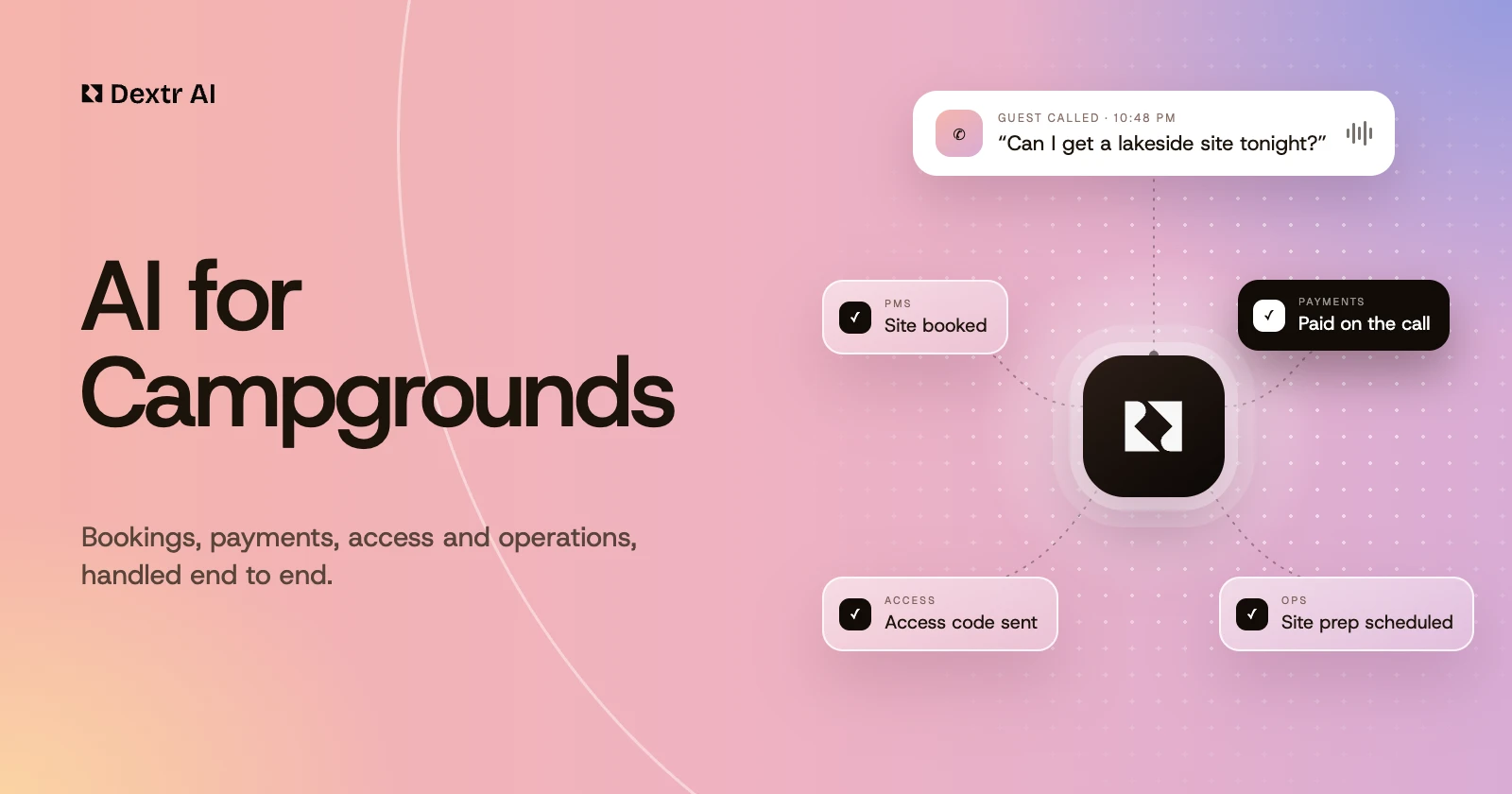
Campers call and text at all hours, and most campgrounds run on a lean front desk. How AI agents can book sites, take payment, send access codes, route site prep and keep guests informed when the weather turns.
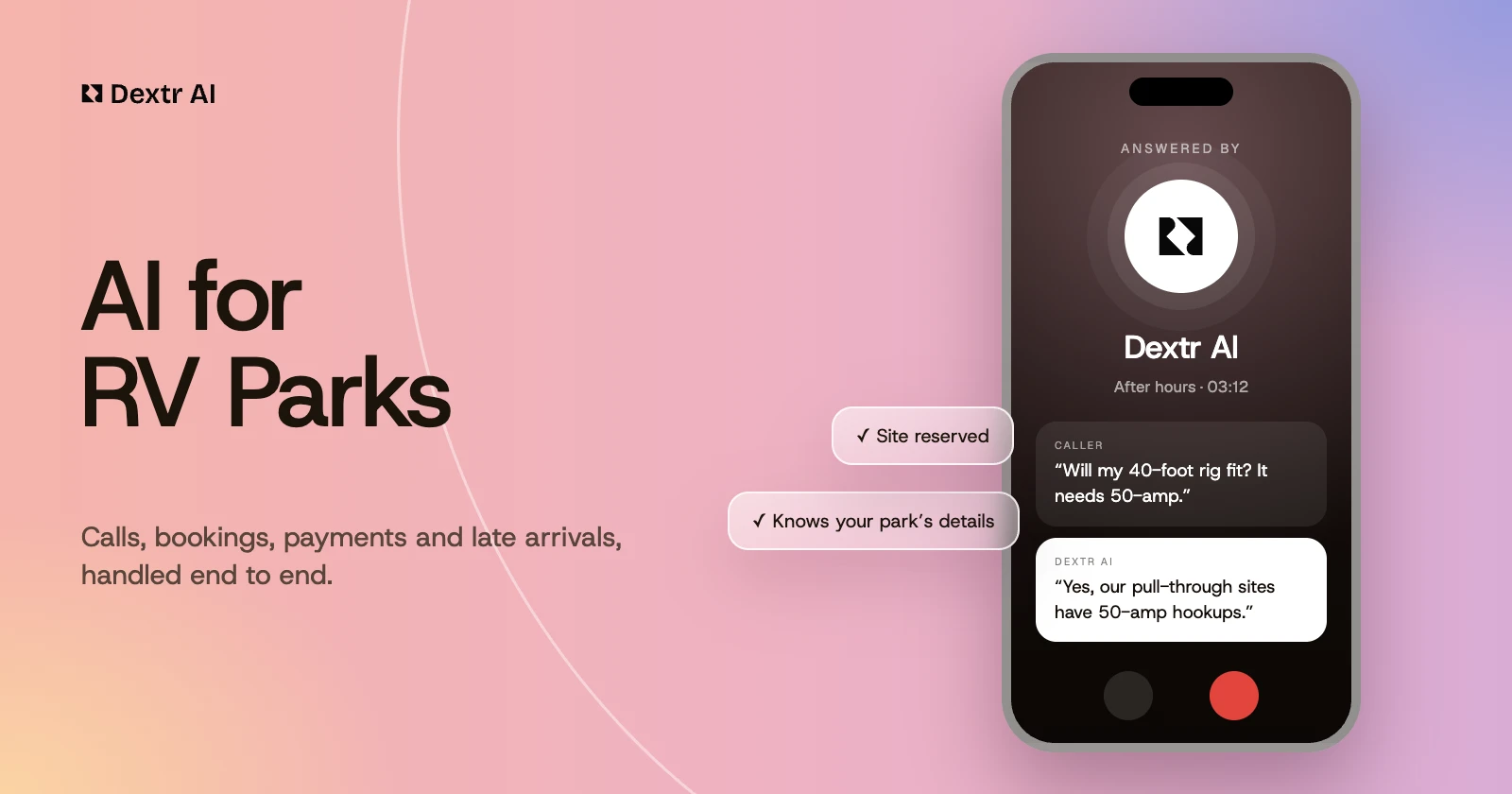
RV parks get questions hotels never do: rig length, amperage, pull-throughs, monthly rates. How AI agents can answer them, book and take payment on the call, and leave the exceptions to your team.
Beyond the headlines about queues and dynamic pricing: how AI agents can sell tickets, handle season passes and group bookings, and answer guests at any hour, and what staff should keep.
Deepak Sharma · Read article
Ready to grow your business?
×
The demo scheduler is provided by HubSpot and uses functional cookies. Allow functional cookies to book a time here, open the scheduler on HubSpot's site, or use the Inquiry tab.