We use cookies to run this site. With your consent, we also use them for our demo scheduler, analytics and marketing, including identifying the companies and people who visit us. Change your choice anytime under "Cookie Preferences".Privacy Policy
🚀 Dextr AI raised $6.7M to bring an AI workforce to hospitality.🚀 Dextr AI raised $6.7M to bring an AI workforce to hospitality.
How to Choose a Hotel Phone System in 2026 (and Stop Missing Calls with AI)
A hotel phone system runs every guest room line, the front desk and the calls that turn into bookings. Here is how to choose one, from PBX versus cloud and real costs to six systems compared, and how to stop missing calls with AI answering without replacing anything.
To choose a hotel phone system in 2026, pick one that connects to your PMS, works with your guest room phones, sends 911 calls to the front desk with the room number and fits a five-year budget. For guest rooms, Phonesuite, Cloud5, Mitel and Alcatel-Lucent Enterprise link to hotel PMSs; general cloud phones such as RingCentral and Zoom Phone suit the back office. To stop missing calls, forward the ones your staff can’t answer to AI answering, which works with any of them.
I wrote this guide from the vendors’ own documentation and from Dextr AI’s work connecting its AI workforce for hospitality to hotels’ existing phone lines. Below, I cover what a hotel phone system does, PBX versus cloud, what it costs, the six systems compared, how to add AI answering step by step, the questions to ask a vendor and how Daisy by Dextr AI works as an AI hotel phone system.
Key takeaways
Start with the PMS interface. Check-in, wake-up calls, room status and call charges all depend on it, so confirm the interface for your exact PMS and version.
Phonesuite, Cloud5, Mitel and Alcatel-Lucent Enterprise link to hotel PMSs. General cloud systems such as RingCentral and Zoom Phone need hospitality apps, or suit the back office.
Only the general cloud systems publish prices, from $16 to $35 a user a month billed annually. Hotel systems are quoted, so compare five-year totals.
Since 2020, new systems must let guests dial 911 without a prefix and alert the front desk, and fixed phones must send the room’s location.
You don’t need a new phone system to stop missing calls. Forward unanswered and after-hours calls to an AI agent that books in your PMS, and keep your number and phones.
What Does a Hotel Phone System Do?
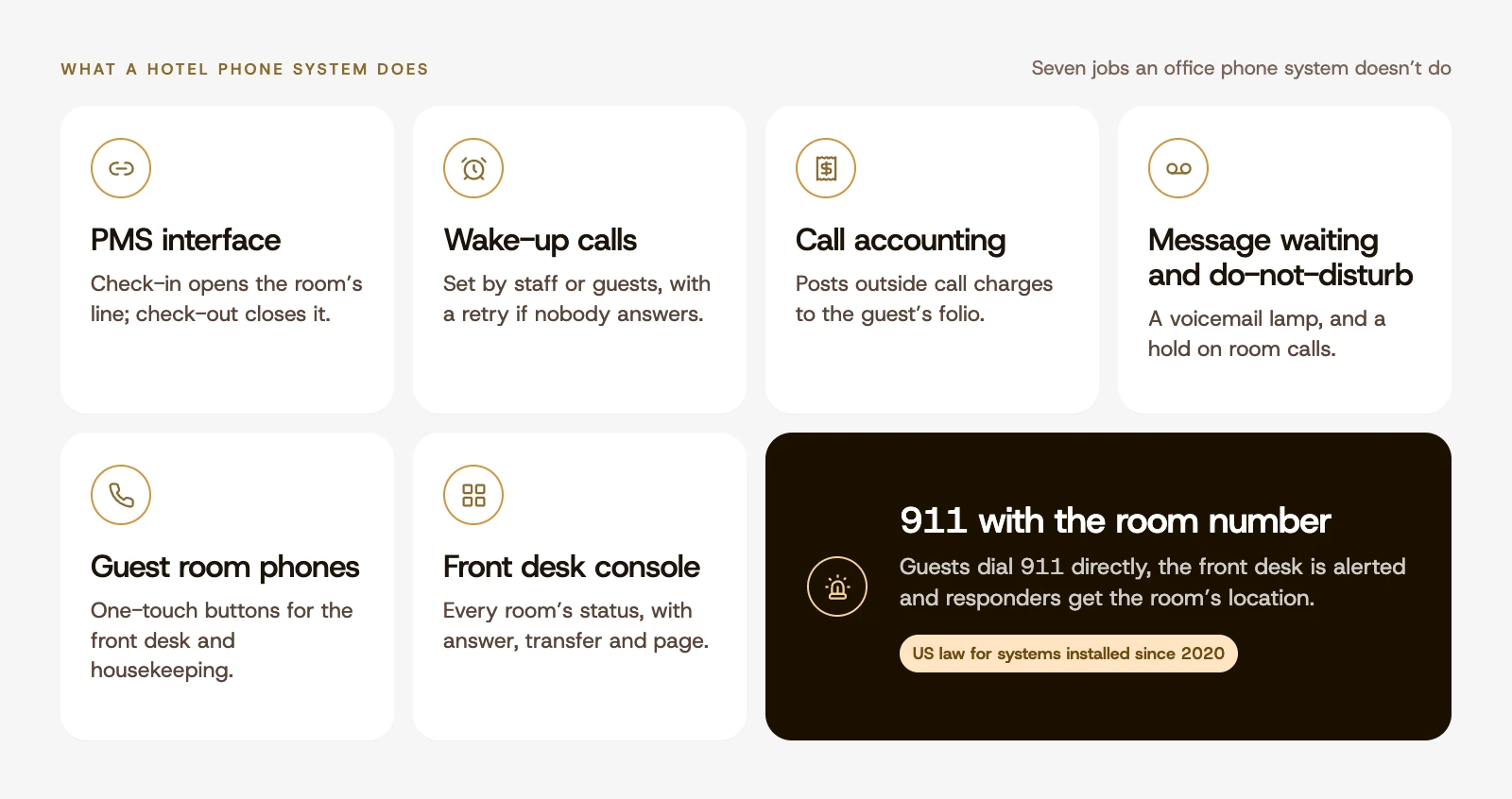
A business phone system routes calls. A hotel phone system also runs guest rooms, which takes a handful of features an office system lacks:
A PMS interface. Check-in opens the room’s line and shows the guest’s name to the operator; check-out closes the line and clears the voicemail. On many systems, housekeeping can also update room status by dialing a code from the room phone.
Wake-up calls. Set by the front desk or by the guest, with a retry and an alert to staff when nobody answers.
Call accounting. Prices outside calls and posts each charge to the guest’s folio.
Message waiting and do-not-disturb. A lamp on the room phone shows a waiting voicemail, and do-not-disturb holds calls to the room.
Guest room phones. Hospitality phones with one-touch buttons for the front desk, housekeeping and room service, usually with a faceplate you can brand.
A front desk console. Shows each room’s status and lets one person answer, transfer and page.
911 that reaches help with the room number. This one is the law, not a feature, as the next paragraph explains.
Two US laws apply to every multi-line phone system a hotel buys or installs. Kari’s Law is named after Kari Hunt, who was killed in a Texas motel in 2013 while her daughter’s 911 calls failed because the phone needed a 9 first. It requires systems sold or installed after February 16, 2020 to dial 911 without a prefix and to alert someone on site, such as the front desk. RAY BAUM’S Act adds a dispatchable location: since January 6, 2021, fixed phones must send the street address plus the room, so responders don’t head for the lobby (FCC).
Hotel PBX vs Cloud Phone Systems
Every hotel phone system is one of three set-ups. The right one depends less on the brand than on your building, your internet line and who will look after it:
The three ways to run a hotel phone system
Set-up
How it works
Costs
Watch out for
On-premise hotel PBX
A phone server on site runs the guest room lines and the PMS interface
Higher up front for the server, licenses and installation; lower each month
Maintenance contracts, end-of-life hardware and someone to manage upgrades
Cloud hotel phone system
The provider runs the PBX in its data centers; phones connect over your network
Low up front; a monthly fee per user, extension or room
What happens to calls, including 911, when your internet line fails
Hybrid
An on-site system keeps the guest rooms, while cloud lines serve the back office or trunks
Some of each
Two systems to support and two bills to read
Older buildings often keep copper wiring to the rooms, which favors an on-premise or hybrid system with analog room phones. A new build or a full renovation can run the guest rooms on IP phones and move everything to the cloud.
How Much Does a Hotel Phone System Cost?
A hotel phone system has more parts than an office one, and a quote can price each of them separately:
Phones: a guest room phone for every room, plus phones for the front desk and staff.
The system: an on-premise server and licenses, or a cloud subscription per user, extension or room.
The PMS interface: usually a separate license.
Call accounting, voicemail and wake-up calls: built in on some systems and extra on others.
Lines: SIP trunks or carrier lines, plus a 911 location service.
Installation: cabling, programming and staff training.
Support: a maintenance contract for an on-premise system, or part of the monthly fee in the cloud.
Only the general cloud systems publish prices. RingCentral’s RingEX costs $20 to $35 a user a month billed annually, and Zoom Phone $16 to $24.50, and neither price includes hotel features. Phonesuite, Cloud5, Mitel and Alcatel-Lucent Enterprise quote each property.
To compare quotes fairly, put them on the same footing: the total over five years, with phones, installation, the PMS interface, lines and support included.
Hotel Phone Systems to Shortlist in 2026
Four of these systems are built or set up for hotels, with a PMS link for check-in, wake-up calls and room status. The other two are general cloud phone systems that suit a hotel’s back office, or its guest rooms with a hospitality app added:
Phonesuite: Hotel Phone Systems in the Cloud or On Site
Phonesuite builds phone systems for hotels, hosted in the cloud or run on site as Voiceware. It says it integrates directly with more than 60 PMSs, including OPERA, Choice Advantage, SkyTouch, Visual Matrix and HotelKey, takes room status updates through maid codes, sets wake-up calls and works with almost any handset. Its on-premise system is built to meet Kari’s Law and RAY BAUM’S Act. Pricing is by quote.
Cloud5: Hosted and On-Premise Hotel PBX
Cloud5 Communications sells hosted and on-premise hotel phone systems, along with SIP trunking and E911 services. Its hosted PBX integrates with major PMSs, including Oracle, MSI, Galaxy, FOSSE, OnQ and Sabre, and includes wake-up calls, call accounting and an auto-attendant. Its on-premise service supports analog and IP guest room phones and existing Avaya, Hitachi, Mitel, NEC and Nortel systems. Pricing is by quote.
Mitel: Hospitality PBX On Site, Hybrid or in the Cloud
Mitel runs hotel phone systems on site, as a hybrid or in Mitel Secure Cloud for Hospitality. Its hotel software links to the PMS over the FIAS standard for check-in and check-out, room status, wake-up calls and call charges, with Mitel 6900 IP phones for rooms and staff and support for emergency calling such as Kari’s Law. Mitel completed a financial restructuring in June 2025, so ask about the roadmap for the product you’re quoted. Pricing is by quote.
Alcatel-Lucent Enterprise: Hotel PBX and Rainbow Hospitality
Alcatel-Lucent Enterprise runs hotels on its OmniPCX Enterprise and OXO Connect phone systems on site, with hotel PMS links that cover check-in and check-out, room status, wake-up calls and call billing. For the cloud, Rainbow Hospitality is a cloud phone system that links to OPERA Cloud. Pricing is by quote.
RingCentral: General Cloud Phone System With Hospitality Apps
RingCentral is a general cloud phone system with no hotel features of its own. PMS links, wake-up calls and call accounting come from hospitality apps in its app gallery, such as DuVoice. It supports 911 notification by default and sends the address you register for each desk phone. RingEX costs $20, $25 or $35 a user a month billed annually, or $30, $35 or $45 billed monthly (pricing).
Zoom Phone: Cloud Phone System for the Back Office
Zoom Phone is a cloud phone system without hotel features such as a PMS link or wake-up calls, which makes it a better fit for back-office lines than for guest rooms. It supports E911 with room-level detail in the address and several ways to alert staff when someone dials 911. Plans run from $16 to $24.50 a user a month billed annually, or $18 to $29 billed monthly (pricing).
Running NEC or Avaya today?
NEC said in 2024 that it would leave the on-premise PBX business outside Japan, and Forerunner Technologies took over NEC’s on-premise business in the Americas in 2025, so hotels on an NEC system should plan what comes next. Avaya’s IP Office product page doesn’t mention hotels, so confirm how your hotel features are supported before you renew.
How to Add AI Answering to a Hotel Phone System
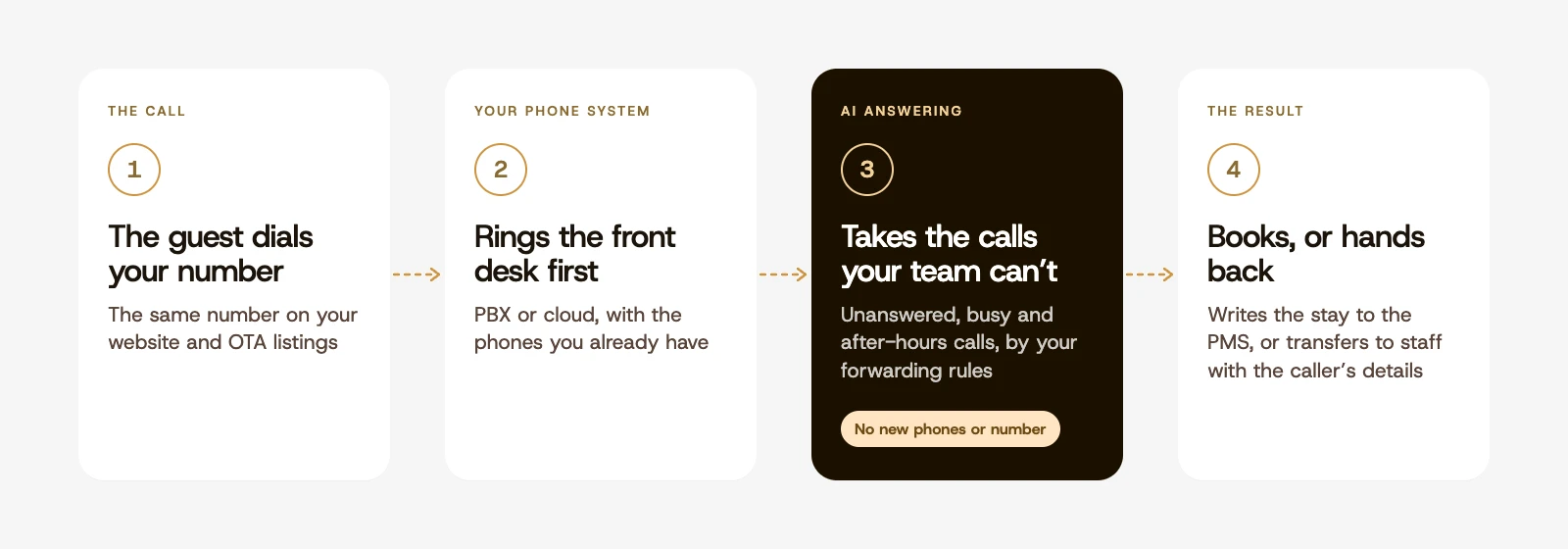
You don’t need a new phone system to stop missing calls. AI answering works in front of the one you have: your system keeps ringing the front desk first, and the calls nobody picks up go to an AI voice agent that can answer, book and hand back.
1. Measure the Calls You Miss Today
Pull a month of call logs or call-accounting reports: calls by hour, unanswered calls and calls that went to voicemail. That baseline is how you’ll judge the AI later: at a 50-plus property hotel chain, the AI answered 3.5 to 3.9 times more calls than the human channel had been handling.
2. Decide Which Calls the AI Takes
Most hotels start with after-hours and unanswered calls on the main number, or with the reservations line alone. Keep calls from guest rooms with your staff at first. If you are still choosing the AI, the best AI receptionists for hotels differ most on whether the call ends with a booking in your PMS.
3. Set the Forwarding Rules in Your Phone System
Use the forwarding your system already has: forward on no answer after a set number of rings, on busy, and on a schedule for after-hours, or point an overflow group or the reservations option of your auto-attendant at the AI’s number. Your number, phones and extensions stay the same; larger properties can connect over SIP instead.
4. Connect the AI to Your PMS
With read and write access to the PMS, the AI checks live rates and books the stay instead of taking a message, so plan how you’ll connect AI to your hotel PMS before go-live.
5. Set the Hand-Back Rules
List what always goes to a person: group and event enquiries, complaints, VIPs and anything urgent. The AI should transfer to the front desk or an on-call phone with the caller’s details, and take a message when nobody answers.
6. Take Deposits Without Card Numbers in the Call
The AI should send a secure payment link or use your payment gateway’s tokenization, so card numbers never enter the conversation or the call recording.
7. Tell Callers They’re Talking to AI
Open every call with a short disclosure, and check the recording-consent rules where your callers live; some US states require every party’s consent. The rules on AI disclosure and recording cover the main ones.
8. Test, Go Live and Compare
Call it as a guest at 2 a.m., book a room, ask for a transfer and hang up halfway through a booking. After go-live, compare answered calls, bookings and missed calls with your baseline.
How Dextr AI does it
Daisy by Dextr AI answers forwarded calls in under two seconds, books and changes stays in more than 50 PMSs and takes the deposit during the call. It goes live in about seven days with no setup fee, and your phone number, phones and PMS stay as they are.
9 Questions to Ask a Hotel Phone System Vendor
Ask for each answer in writing, and see the PMS interface working on a test system before you sign:
Do you have a certified interface for my PMS and version, and what does it cost? The interface license is often a separate line on the quote.
Which events pass between the PMS and the phones? Check-in, check-out, room moves, guest names, wake-up calls, room status and call charges should all sync.
How does a 911 call reach the front desk, and does each room phone send its own location? Ask to see the notification and the dispatchable location in a test call.
What happens when the internet goes down? For a cloud system, ask how calls and 911 keep working, and whether there is a backup line.
Will my existing guest room phones work? Analog phones need gateways on an IP system, and some features only work on the vendor’s own handsets.
How is call accounting handled, and who sets the rates? Find out whether it is built in or a separate product.
Can I forward unanswered, busy and after-hours calls to an outside number or SIP address on a schedule? That is what lets you add AI answering later without a project.
What does support include, and how fast is on-site help? Get the hours, the channels and the response time for a system that is down.
What are the contract length and the price per room or per user? Ask what adding lines, rooms or a second property will cost.
Daisy by Dextr AI: An AI Hotel Phone System
Daisy is the voice agent in Dextr AI’s AI workforce for hospitality, and it turns the phone system you already have into an AI hotel phone system. The calls your front desk can’t take go to Daisy, which answers in under two seconds, day or night, and finishes the job instead of taking a message.
Answers every call: 24/7, in under two seconds, on your current number.
Books in your PMS: checks availability, quotes the rate, books, changes and cancels stays in more than 50 PMSs and takes the deposit during the call.
Hands back with context: anything it shouldn’t handle goes to your staff with the caller’s details attached.
Keeps your setup: your number, phones and PMS stay as they are, and it goes live in about seven days with no setup fee.
Daisy at The Hendrix
At The Hendrix, a boutique hotel, Daisy answered more than 117 calls with none missed in its first five days and confirmed 11 stays with deposits, worth $3,225.
The Bottom Line on Hotel Phone Systems
The right hotel phone system talks to your PMS, gets 911 calls to help with the room number and costs what you planned over five years. Phonesuite, Cloud5, Mitel and Alcatel-Lucent Enterprise cover guest rooms; general cloud phones suit the back office. Whichever you choose, the calls your team misses are bookings you can recover without new phones: forward them to an AI agent that books in your PMS.
Frequently Asked Questions About Hotel Phone Systems
What is a hotel phone system?
A hotel phone system is the PBX, on site or in the cloud, that connects guest rooms, the front desk and the back office, and links to the PMS for check-in and check-out, wake-up calls, room status and call charges. It also has to meet 911 rules: direct dialing, an alert to the front desk and the room’s location.
What is a hotel PBX?
A hotel PBX (private branch exchange) is the switch that runs a hotel’s internal extensions and outside lines, with hospitality features such as a PMS interface, wake-up calls, message waiting and call accounting. It can run on a server at the hotel or as a cloud service.
How much does a hotel phone system cost?
General cloud systems publish per-user prices, from $16 to $35 a user a month billed annually for Zoom Phone and RingCentral, but those prices don’t include hotel features. Hotel-specific systems are quoted for your property, and the total includes room phones, the PMS interface, installation, lines and support, so compare five-year totals.
Is a cloud or on-premise phone system better for a hotel?
Cloud costs less up front, scales easily and moves maintenance to the provider, but it depends on your internet line, so ask how calls and 911 keep working in an outage. On-premise suits older buildings with copper wiring to the rooms and hotels with on-site IT, and hybrid systems keep room phones on site while the rest moves to the cloud.
Do hotel phone systems have to follow 911 rules?
Yes, in the US. Under Kari’s Law, systems sold or installed after February 16, 2020 must dial 911 without a prefix and alert someone on site, such as the front desk. Under RAY BAUM’S Act, fixed phones must send a dispatchable location, the street address plus the room, since January 6, 2021.
Which hotel phone systems integrate with a PMS?
Phonesuite says it integrates directly with more than 60 PMSs, Cloud5 with major ones including Oracle, MSI, OnQ and Sabre, Mitel through the FIAS standard and Alcatel-Lucent Enterprise through its own hotel PMS links. General cloud systems such as RingCentral rely on third-party hospitality apps.
Can I add AI answering without replacing my phone system?
Yes. Forward unanswered, busy and after-hours calls, or the reservations line, from your current system to the AI’s number; your number, phones and extensions stay the same. Connect the AI to your PMS so it books instead of taking messages, and set rules for what goes back to staff.
Does it cost to use hotel room phones?
Each hotel sets its own rates. Calls to the front desk and other rooms are usually free, while outside calls are priced by the hotel’s call accounting and added to the folio, so check the rate card by the phone.
Growth and search specialist with hands-on experience in the AI sector. Covers AI agents, voice AI and automation, and how businesses evaluate and adopt them.
Thirteen AI receptionists for hotels compared on what decides the choice: does the call end with the booking in your PMS and the deposit taken? Nine built for hotels and four general-purpose tools, with published prices worked out for a 60-room hotel, a booking call step by step, lessons from Dextr AI's deployments, demo questions and the rules on disclosure and card payments.
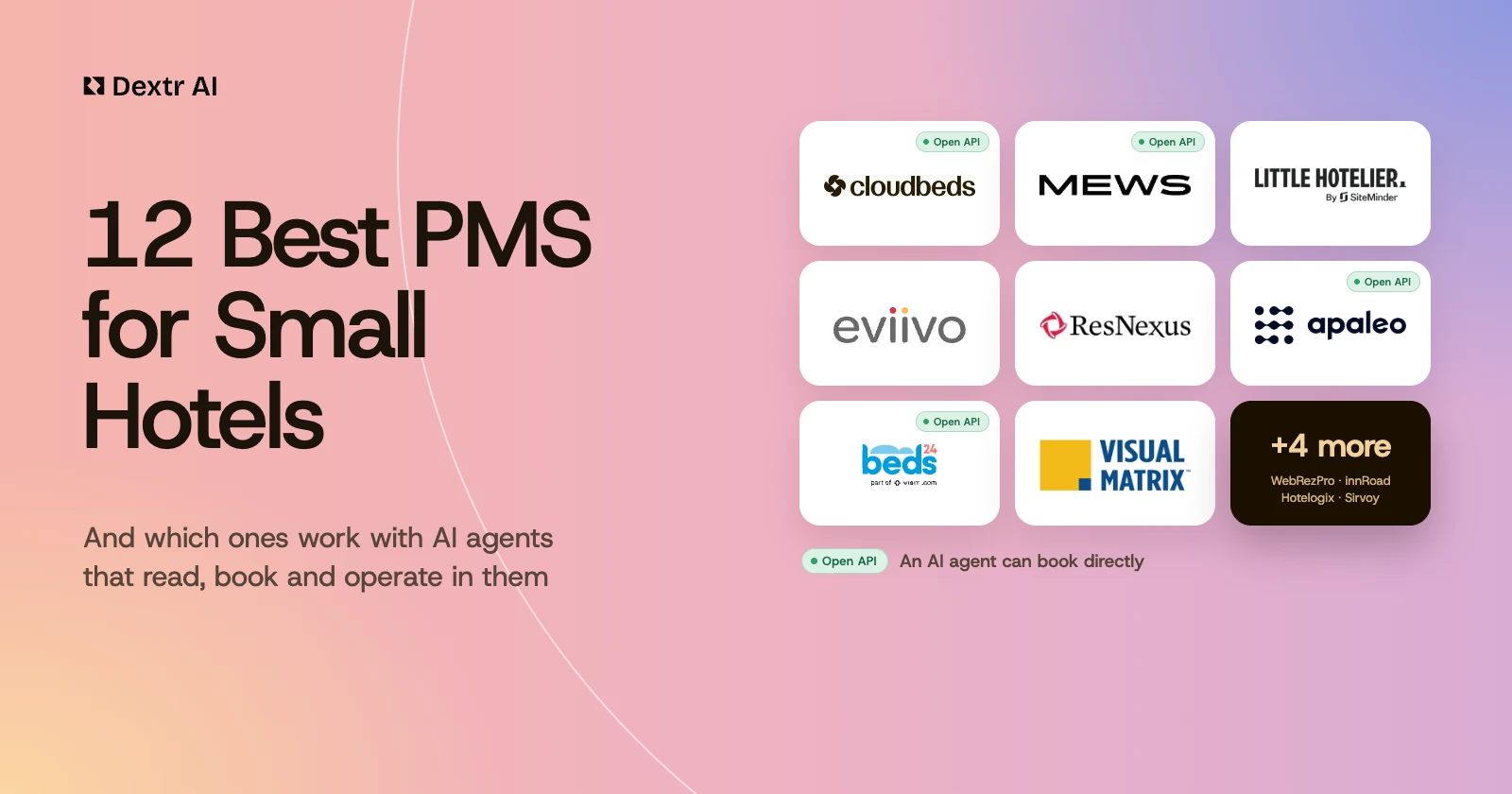
Twelve property management systems built for small hotels, inns and motels, compared on who each suits, what it costs and how far an AI agent can go inside it: read availability, book and take deposits, or update rooms and tasks. With published prices, the questions to ask a PMS vendor about AI and lessons from Dextr AI's deployments.
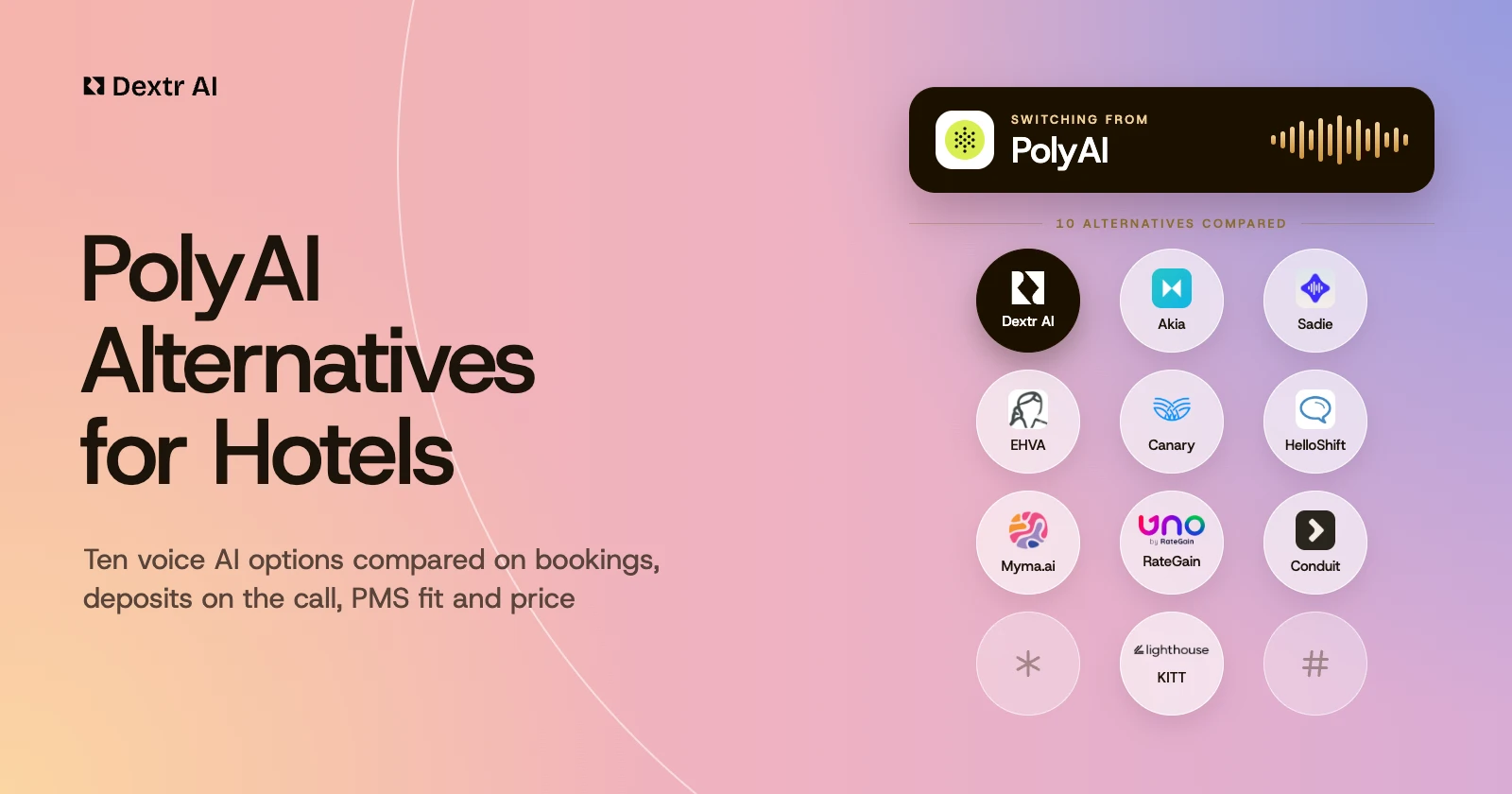
Ten PolyAI alternatives for hotels compared on what decides a switch: does the call end with the booking and deposit in your PMS, is your PMS already connected, who builds the agent, and what does it cost? With published prices, a plan to move your phone lines and demo questions.
Deepak Sharma · Read article
Ready to grow your business?
×
The demo scheduler is provided by HubSpot and uses functional cookies. Allow functional cookies to book a time here, open the scheduler on HubSpot's site, or use the Inquiry tab.